


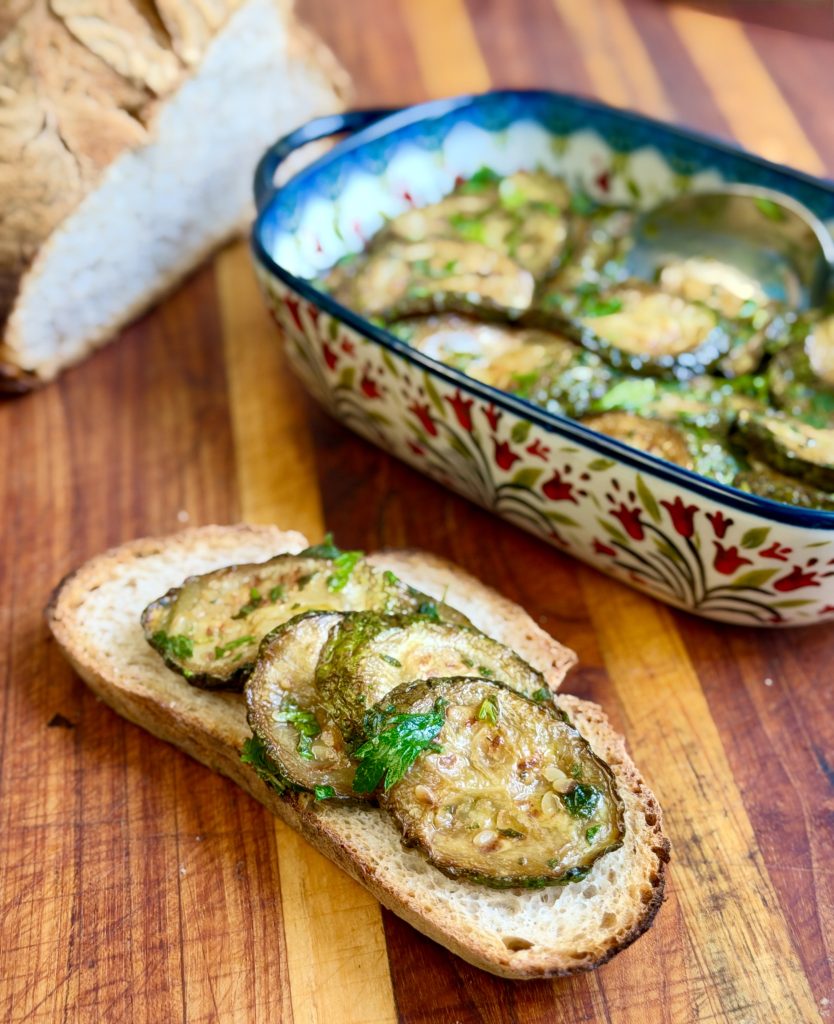
Concia di zucchine is a centuriees old classic of the Roman Jewish kitchen.
During my recent Substack Live with Judy Witts Francini and Giovanna Solimando, Judy reminded me of this dish, and I realized that, in all these years of blogging, I’d hever gotten around to writing about it. It’s an almost unforgivable omission. Not only did I live in Rome for many years, but for most of those years I lived only a few blocks from the Ghetto, where this dish originated! But better late than never, as they say.
Like scapece, concia di zucchine is essentially fried and marinated zucchini, but it has some of its own unique characteristics, first and foremost the use of the lovely Roman varietal called zucchina romanesca and the quintessentially Roman mint called mentuccia. Sadly, both are difficult, if not impossible to find here in the US and I’m guessing elsewhere, and it’s not really possible to reproduce the precise taste and texture of concia without them. But no worries, even a dish made with standard zucchini and mint will be delicious.
Concia di zucchine is a versatile dish. You can serve it as an antipasto, on top of bread, as a side for grilled, roasted or boiled meats or fish, or as part of a summer buffet. I’ve had it on grilled bread with stracciatella cheese and it was amazing.
Ingredients
Serves 4-6
- 1 kilo (2 lbs) zucchini, preferably Roman zucchini (about 5-6)
- oil for frying
For the marinade:
- Fresh parsley, to taste
- Fresh mint, preferably Roman mint, to taste
- 2-3 cloves garlic
- wine vinegar
- olive oil
Directions
Prep and fry the zucchini
Trim off the ends, then slice the zucchini on an angle into thin, but not too thin, ovals.
Place the zucchini slices in a single layer on a clean dish towel, then cover with another towel. Let dry for at least an hour.
Heat oil at least 3 cm (1 inch) deep in a large pan until very hot but not smoking, about 180C/350F. Add as many zucchini slices as can fit comfortably in a single well-spaced layer and fry them until golden brown, turning them with a skimmer to ensure they brown evenly on both sides. Repeat until you’ve fried all the slices.
As you go, transfer each batch to a bowl or platter lined with paper towels and salt them lightly.
Marinating the zucchini
Trim off their stems, then finely mince together the mint and parsley leaves. Chop the garlic separately into small pieces.
In a casserole or container, place down a layer of zucchini slices. Sprinkle them with some of the minced herbs, then a little chopped garlic here and there. Drizzle lightly with the vinegar, then with the olive oil.
Repeat until you’ve used up all the zucchini. Omit the garlic from the last layer.
Let the zucchini sit covered for at least a few hours, even better overnight in the fridge.
Serve
Serve at room temperature.
Notes on concia di zucchine
The usual tips for frying apply here. Most importantly, maintain a constant moderately hot temperature of around 180C/350F. So don’t crowd the pan. If you have a candy thermometer or deep fat fryer you can set to that temperature, it’s good to use it. I just recently bought a Breville countertop induction burner called the Control Freak and it works like a charm for maintaining a constant temperature.
Other than the frying, the recipe is a piece of cake, really. You just need patience. Both the intial drying and the marination take time but are critical for success. This is not a recipe you can rush.
Choosing and prepping your zucchini
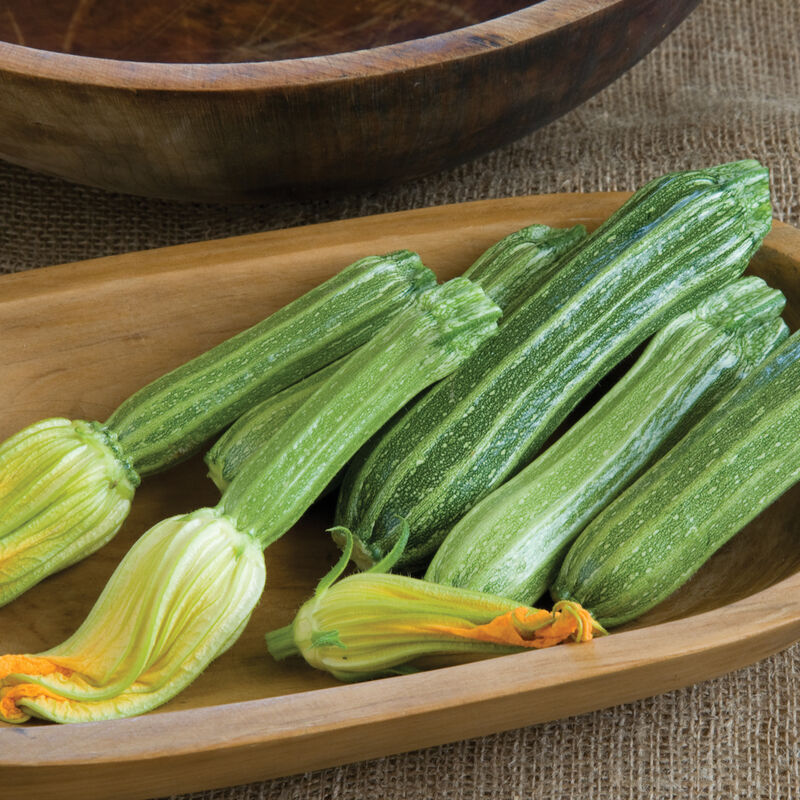
Classically, as mentioned at the top, you use Roman zucchini, the gorgeous zucchina romanesca, for making concia. This varietal has characteristic white flecks and ribbing down its length, which produces a lovely star-shaped slices. It is usually sold with its blossom still attached. It has a unique nutty, slightly bitter flavor that may win you over even if you’re not a zucchini lover. Unlike most zucchini, doesn’t turn mushy when cooked, which makes it perfect fot making concia.
Sadly, I’ve not been able to find zucchine romanesche where I live. But you can buy seeds online and grow them yourself. Zucchini are very easy to grow and once they get going, produce a prodigious amount of fruit. As a bonus, you get the blossoms which are very hard to source, at least where I live.
As mentioned above, the drying is critical. The zucchini need to lose their excess moisture so they brown nicely. Aside from the kitchen towel method, you can leave them out in the sun for an hour or two if you live in a dry, sunny climate.
You should slice your zucchini fairly thin so the marinade can soak through, but not so thin they break apart after frying, bearing in mind that the slices will shrink quite a bit as they fry. Unless you’re using zucchine romanesche, any thinner than say 3/4 cm (roughly 1/4 inch) and the slices will tend to break apart. Many recipes call for slices about 1 cm and some, including Ada Boni‘s in her La cucina romana, even 2 cm thick.
Preparing the marinade
Another hard to find, typically Roman ingredient is mentuccia, called Lesser Calamint in English. I’ve never seen it sold as a culinary herb where I live, but again, it is fairly easy to find the seeds as Lesser Calamint is used as a decorative plant.
The taste of mentuccia is sometimes descrbed as a cross between mint and oregano, as it has a musky flavor. If you don’t have mentuccia on hand, you can simply use another mint instead, perhaps combined with a little fresh oregano or marjoram to mimic the taste of mentuccia. Don’t use dried oregano, however, as it would overwhelm the other flavors.
I’ve left the measurements for the herbs to your discretion, as it’s really a matter of taste. But if you need a guide, you could use enough say about a half cup of freshly minced herbs by volume.
As for the garlic, again it’s a matter of taste, but don’t overdo it. There are even some folks who omit it entirely. Again, it’s up to you.
Variations
The recipes for concia is remarkably consistent across recipes. Maybe that’s because the recipe as such is so very flexible? But there are a few minor variations of note.
There are two ways to slice the zucchini for making concia. You can slice it on the bias into ovals as called for here, or cut each zucchini into two, then into lengthwise strips. Thickness can also vary, as noted above.
The herbs you add to the marinade can vary as well. Mint is typical, but you will see recipes that call for basil instead. And some that call for all mint or basil, rather than a mix.
Ada Boni’s recipe has you bring the vinegar to a boil before pouring it over the zucchini slices, better to soak in, I assume.
In older recipes, you fry the zuchini slices in olive oil, then use some of the frying oil for the marinade. But this modern take using fresh uncooked olive oil for the marinade is not only more economical given the price of quality olive oil these days, but surely has a cleaner taste.
The charming Roman YouTuber called Ruben likes to mix all the marinate ingredients—vinegar, herbs, garlic and olive oil—all together in a bowl, then toss the fried zucchine slices as if making a salad.
In her wonderful book The Classic Cuisine of the Italian Jews, Edda Servi Machlin says that, a bit like scapece, concia can also be made with eggplant, although “the texture is less desirable than that of zucchini”. If you do go this route, although it’s obviously not traditional and I haven’t actually tested it, I imagine that long Asian eggplants would work particularly well.
Origins of concia
There are various theories about how concia got its name as the words has several meaning in Italian or romanesco, the Roman dialect. Probably the most common relates to the verb conciare, which means to season or preserve.
But my favorite theory brings us all the way back to Ancient Rome and the famed cookbook De re coquinaria attributed to Apicius, which has a recipe for preparing vegetables using a method referred to as concinaria or tanning (aka drying), in the sun, followed by pan frying. He’s also credited with the original recipe for scapece.
Since the Jewish community in Rome has been there since ancient times, it is not inconceivable that they have preserved this ancient dish as part of their culinary tradition. But at the very least, this recipe goes back centuries.
Making concia ahead
Concia has to be made ahead, obviously. But you shouldn’t keep it too long as the marinade (in particularly the garlic) grows stronger with each passing day. In her book Edda Servi Machlin says that concia freezes well if you want to keep it longer than a few days, though I’ve never had occasion to try it myself.
Concia di zucchine
Ingredients
- 1 kilo 2 lbs zucchini, preferably Roman zucchini (about 5-6)
- oil for frying
For the marinade:
- Fresh parsley to taste
- Fresh mint preferably Roman mint, to taste
- 2-3 cloves garlic
- wine vinegar
- olive oil
Instructions
Prep and fry the zucchini
- Trim off the ends, then slice the zucchini on an angle into thin, but not too thin, ovals.
- Place the zucchini slices in a single layer on a clean dish towel, then cover with another towel. Let dry for at least an hour.
- Heat oil at least 3 cm (1 inch) deep in a large pan until very hot but not smoking, about 180C/350F. Add as many slices as can fit comfortably in a single well-spaced layer and fry them until golden brown, turning them with a skimmer to ensure they brown evenly on both sides. Repeat until you’ve fried all the slices.
- As you go, transfer each batch to a bowl or platter lined with paper towels and salt them lightly.
Marinate the zucchini
- Trime off their stems, then finely mince together the mint and parsley leaves. Chop the garlic separately into small pieces.
- In a casserole or container, place down a layer of zucchini slices. Sprinkle them with some of the minced herbs, then a little chopped garlic here and there. Drizzle lightly with the vinegar, then with the olive oil.
- Repeat until you’ve used up all the zucchini. Omit the garlic from the last layer.
- Let the zucchini sit covered for at least a few hours, even better overnight in the fridge.
Serve
- Serve at room temperature.
Nutrition
Discover more from Memorie di Angelina
Subscribe to get the latest posts sent to your email.

I met Judy in Italy a few years ago! Never had zucchini this way, but I know I’d love it! Now I just need my zucchini to produce some full size fruit! Never had such a bad year with them 🙁
That’s too bad, Christina! I tried growing my own last year and didn’t have much luck, either. But then I was trying to grow them in pots. Didn’t work!
This concia di zucchine looks so damn good, super simple but with that Roman magic that makes you wonder why you don’t fry and marinate zucchini more often.
Thanks, Raymund!
This is a must try recipe! I have wild marjoram growing all over my garden, which reminds me of Italy. I really should grow my own zucchini as we also don’t get them with the blossoms still attached here!
Thanks so much, Tandy! Here, too, you usually need to grow your own to get the flowers.
What a great way to take advantage of 2 things that are plentiful in mid-late summer: zucchini and mint. I would never have thought about pairing these flavors together, but this sounds like a fantastic recipe, Frank. And being the ancient Rome lover that I am, I’m extra intrigued by this one!
Thanks so much, David! They really marry perfectly.
Dear, dear, I have completely forgotten about this beauty !!!!!!!!!!!!! With the abundance of zucchini now, it is just the perfect timing……. Thank you!
You’re welcome! It’s a winner, especially if you have a surfeit of zucchini.
Thank you for posting this, Frank! My Barese grandmother used to make this and I always loved it. No mint, though. We have some wild mint growing in our yard so I will definitely use it when I make this.
Hope you like it, Janet!
This sounds so good – especially with Stratiatella ! What about marjoram?
I could certainly see using marjoram in the marinade. It marries so well with zucchini. And as mentioned mentuccia kinds of tastes like a cross between mint and marjoram.
Ohhh ooops! I guess I missed that! I’m growing it now (marjoram) even though it’s not my favorite herb. It’s just a bit perfumey for me!
I like it but a little does go a long way.
these sound delicious Frank. There’s a restaurant near us who cannot take their fried zucchini chips off the menu! just too good.
cheers
sherry https://sherryspickings.blogspot.com/
I can see why. Zucchini chips are addictive.
This recipe hit my inbox this morning and I thought it would be perfect as a side for a chicken dinner I had planned for my husband and myself (Americans retired in Greece). Here, the only zucchini in the stores are the romanesco variety, which I used in the recipe. Turned out fantastic . . . so good that I’m planning to use thinly sliced grilled Japanese eggplant in the same way. Great recipe! Thanks.
Wonderful! Do let us know how you like the eggplant.
My dad used to make this all the time. I still do.
Excellent. It’s a wonderful way to enjoy this vegetable.
This recipe hit my inbox this morning and I thought it would be perfect as a side for a chicken dinner I had planned for my husband and myself (Americans retired in Greece). Here, the only zucchini in the stores are the romanesco variety, which I used in the recipe. Turned out fantastic . . . so good that I\’m planning to use thinly sliced grilled Japanese eggplant in the same way. Great recipe! Thanks.
Lucky you to have zucchine romanesche where you live! And I’m delighted you enjoyed the dish. Do let us know how the eggplant goes.
We absolutely loved your zucchini fitters recipe so I know we would love this one too. I haven’t seen the mint you write about either, but perhaps in the high end specialty stores like Eataly might have it.
So glad to hear it, Eva! If you do find mentuccia at Eataly, do let us know!
This recipe sounds like an excellent way to add pazazz to zucchini! I didn’t plant any this year but will look for the seeds for this variety next year.
I’m pretty sure you’ll enjoy this, Barb. Thanks for stopping by!
Such a simple yet stunning side dish! Just bought some zucchini, so might give it a go 🙂
Worth a try, Angie. Enjoy!
Love zucchini, live on ‘open sandwiches’, very much like your photo >>> I believe you get the ‘message’ 🙂 ! Must look for the seeds as my patio is full of growing herbs and spring is but a few months away!
If you try it, do let us know how it goes! Did you mean growing mentuccia or zucchini? I actually attempted growing zucchini on my patio last year but it didn’t work out too well.
I remember you discussing this on the Substack Live and thinking it sounds so good. It does look nice and simple and this seems the perfect time, as zucchine are abundant in the farmers market these days.
It’s definitely the right time, David!
That looks delicious and so simple, albeit time consuming to make. However, the time involved makes for delicious recipes! I’m not sure if I can find mentuccia, but the seeds to grow it are definitely available.
So true, MD. Time is a key ingredient in some many of these traditional recipes.