


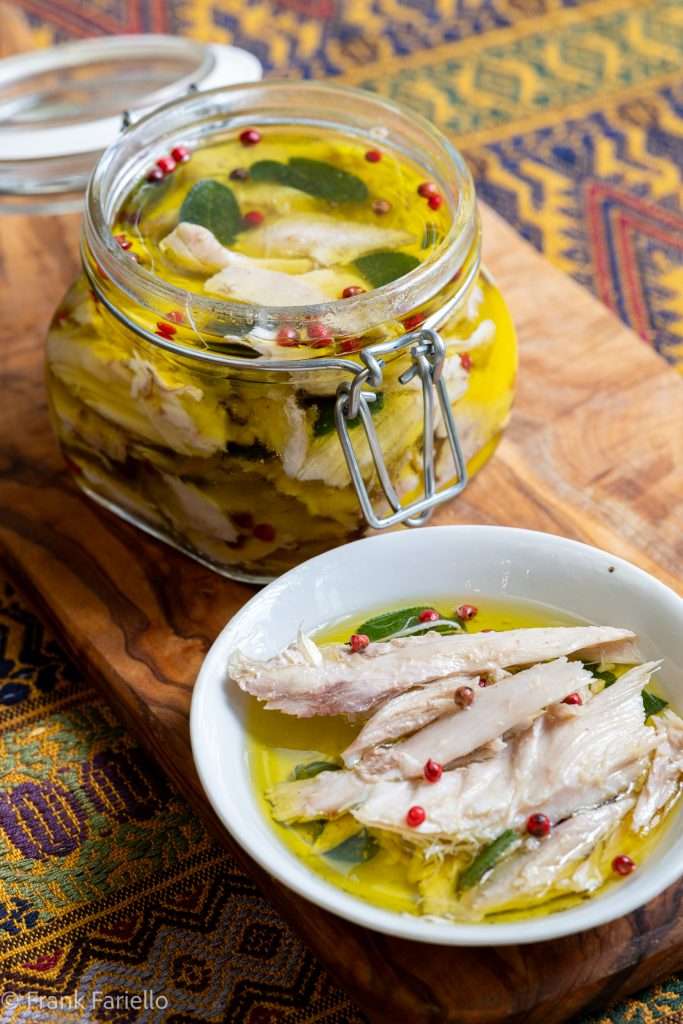
The odd name for this Piedmontese dish, tonno di coniglio, literally means ‘tuna of rabbit’. That name might have you scratching your head, especially when you learn that there’s no tuna in it. Rather, the rabbit is treated as if it were tuna: pre-cooked, deboned then jarred sott’olio, in olive oil.
Yet another Italian dish born out of necessity, in this case as a way of preserving meat for the winter, tonno di coniglio is enjoyed today for its own exquisite taste and sumptuous mouthfeel.
The recipe proceeds in two steps: First, you simmer a rabbit in an aromatic broth until perfectly tender,. Second, you strip the meat off the bone and layer it in a mason jar or other airtight container with garlic, sage, pepper and olive oil and leave it to cure for a few days in scented olive oil so as to let the oil and seasonings infuse the meat with its lovely flavors.
It’s a simple recipe that makes for a delicious antipasto served with toasted bread and perhaps some pickled vegetables, or as a protein forward salad on a bed of lettuce.
For those who are squeamish about eating rabbit, the same method can be used with chicken, with equally delightful results. And don’t throw out the poaching liquid—you can use it to make lovely soups and risotti. The leftover oil, too, can be recycled for dressing salad, sautéing or making sauces.
Ingredients
Serves 4-6 as an antipasto
- 1 young rabbit or chicken (about 1-1..5 kilos/2-3 lbs)
For the aromatic broth:
- 1-2 carrots, trimmed and cut into large pieces
- 1-2 celery stalks, cut into large pieces
- 1 yellow onion, cut in half and each half studded with a clove
- 3-4 juniper berries, lightly crushed
- 1-2 bay leaves
- a pinch of whole black peppercorns
- salt
For the olive oil cure:
- 2-3 garlic cloves, peeled and thinly sliced
- a sprig or two of fresh sage leaves
- whole peppercorns, black or pink
- olive oil
Directions
Simmering
In a large pot, place the onion, carrot, celery, juniper berries, bay leaf and peppercorns and enough water to cover the rabbit. Bring the water to a simmer. Salt very generously and simmer for 10-15 minutes.
Add the rabbit to the pot, topping it up with water if need be so it is completely covered. Simmer until very tender, usually about 1 hour for a rabbit, 30-45 minutes for a chicken.
Let the pot cool completely.
Deboning
When the rabbit or chicken has completely cooled, remove it from the pot and place in a colander to drain. Rinse if need be to remove any scum from its surface. Then pat it dry with paper towels.
Now, working with gloved or impeccably washed hands, pull the meat off the bones in strips. (If using a chicken remove the skin and discard it.)
Curing
Place a sage leaf, a slice or two of garlic and a few peppercorns in the bottom of a mason jar or other airtight container. Drizzle over some olive oil.
Place down a layer of the shredded meat, the top with another sage leaf or two, a few slices of garlic and a few peppercorns, then drizzle with more olive oil. Repeat until you have used up all the meat.
Top up with enough oil to completely cover the meat.
Close the container and store in the fridge (or another chilly place) for at least 2-3 days.
Serving
Remove the jar from the fridge and bring back to room temperature before serving.
Notes on tonno di coniglio
This is a simple recipe, but one that requires a bit of fussy work deboning the rabbit or chicken, then some patience waiting for that two—or much better—three day cure that’s key to its success. The other key point is the quality of the oil, of course. As this is Piedmontese cookery, ideally you’d go for a lighter olive oil, perhaps one of the excellent olive oils from neighboring Liguria (or even Provence) rather than one of the fruity ones from Sicily or Puglia.
Finally be very generous with the salt for the broth. The broth itself may taste overly salty, but the meat needs it. And if you’re a salt fiend like me, you may want to sprinkle a bit into the cure or serve your tonno di coniglio sprinkled with a little salt.
To prevent spoilage, it’s important that the oil completely cover the meat. I find it’s a good idea to top up the jar, then wait for a few minutes for the oil to settle. Then if you need to, top it up again. Don’t worry about your waistline, you let most of it drain off when you serve your tonno di coniglio.
Sourcing the rabbit or chicken
Rabbit isn’t easy to find where I live, but there is at least one upscale supermarket that carries it, albeit at an eye-watering price of $60. The same can be said for online sources. A better bet are ‘ethnic’ supermarkets, where you can find rabbit at a fraction of the cost.
If you are using chicken instead of rabbit, try to find one with real flavor and a proper unflabby texture. An organic, free range bird is best. Also excellent are the ‘yellow chickens’ I can find at my local Chinese supermarket, especially the European-Hong Kong style whole chickens from Bo Bo Poultry based in Brooklyn. Complete with head and feet that you can use for broth, they also have wonderful flavor and excellent firm texture.
Variations
The most common variations in recipes for tonno di coniglio mostly change up the aromatics that go into the broth or oil. Some recipes, for instance, call for rosemary in one or the other, or both. Juniper berries don’t figure in all recipes and sometimes the bay leaf is omitted. In some recipes, white wine or white wine vinegar is added to the broth. Orange or lemon peel also figure in some recipes. And in Liguria, where this dish is also popular, olives, capers and anchovies can go into the jar.
More far afield are modern recipes where change up the cooking method. You can cook the rabbit directly in the oil at a very low temperature, resulting in a kind of confit. You can also cook the meat sous vide instead of simmering it for a particularly tender and juicy result.
And of course, as mentioned, you can vary the main ingredient. Chicken is perhaps the most common substitute, and the closest to the original. But turkey also works. And you can even find recipes for making veal or pork this way.
Making tonno di coniglio ahead
This is a dish that has to be made at least 2 or 3 days ahead. It will keep for several days longer in the fridge. Always make sure that the oil completely covers the meat to prevent spoilage.
If you want to keep your tonno di coniglio any longer than say a week or so, it’d be prudent to sterilize the jars properly. That’s something I never find I need to do since as soon as it’s ready to eat tonno di coniglio disappears quickly in our house.
Tonno di coniglio
Ingredients
- 1 young rabbit or chicken about 1-1..5 kilos/2-3 lbs
For the aromatic broth:
- 1-2 carrots trimmed and cut into large pieces
- 1-2 celery stalks cut into large pieces
- 1 yellow onion cut in half and each half studded with a clove
- 3-4 juniper berries lightly crushed
- 1-2 bay leaves
- a pinch of whole black peppercorns
- salt
For the olive oil cure:
- 2-3 garlic cloves peeled and thinly sliced
- a sprig or two of fresh sage leaves
- whole peppercorns black or pink
- olive oil
Instructions
Simmering
- In a large pot, place the onion, carrot, celery, juniper berries, bay leaf and peppercorns and enough water to cover the rabbit. Bring the water to a simmer. Salt very generously and simmer for 10-15 minutes.
- Add the rabbit to the pot, topping it up with water if need be so it is completely covered. Simmer until very tender, usually about 1 hour for a rabbit, 30-45 minutes for a chicken.
- Let the pot cool completely.
Deboning
- When the rabbit or chicken has completely cooled, remove it from the pot and place in a colander to drain. Rinse if need be to remove any scum from its surface. Then pat it dry with paper towels.
- Now, working with gloved or impeccably washed hands, pull the meat off the bones in strips. (If using a chicken remove the skin and discard it.)
Curing
- Place a sage leaf, a slice or two of garlic and a few peppercorns in the bottom of a mason jar or other airtight container. Drizzle over some olive oil.
- Place down a layer of the shredded meat, the top with another sage leaf or two, a few slices of garlic and a few peppercorns, then drizzle with more olive oil. Repeat until you have used up all the meat.
- Top up with enough oil to completely cover the meat.
- Close the container and store in the fridge (or another chilly place) for at least 2-3 days.
Serving
- Remove the jar from the fridge and bring back to room temperature before serving.
Nutrition
Discover more from Memorie di Angelina
Subscribe to get the latest posts sent to your email.


This is really unique and intriguing, Frank! I’ve never come across tonno di coniglio before – definitely a must-try for me.
Thanks, Ben! It’s little known outside Italy which is why I thought it would be a good one to present here. I think you’d really like this one.
Looking at the title, I honestly thought this was going to be some kind of tuna dish. Tonno had me fooled for a second, then I realised it’s rabbit. Didn’t expect that twist at all. And funny enough, coniglio is so close to conejo, the Spanish word I actually know, but it still didn’t click right away. Anyways the whole process is fascinating. The slow simmer, the careful deboning, the gentle cure in olive oil, it turns into something really elegant and old‑world. Definitely one of those dishes that makes you appreciate how much tradition and patience can transform simple ingredients into something special. Love this!
Yes, it’s a confusing name to be sure! But the taste wins you over..
I can’t say I’ve ever come across anything like this, but I’m intrigued. I bet that olive oil would add so much flavor – but I can also see the importance of using a good quality oil here.
Definitely!
Hoping my comment went thru – I love wild rabbit!
sherry https://sherryspickings.blogspot.com/
Our dad used to hunt rabbits in our childhood so I really loved the taste of wild rabbit! Sadly you can’t buy it here in Queensland (I think!) tho they do sell it down south. Our poor mum had to skin them and cook them, which i don’t think she enjoyed! I bet this dish is great, Frank.
cheers
sherry https://sherryspickings.blogspot.com/
I can imagine! I do enjoy eating rabbit, but I don’t think I’d have the courage to skin one.
Like Barb, rabbit is rather elusive here, but I think this would be wonderful with chicken, as you suggest. I particularly like the use of juniper berries, as the flavor is a favorite of mine, and not because of gin! It’s wonderful in stews and marinades for grilled meats. I definitely want to try this… I just need to figure out the right people to whom I should serve it.
You could always order it from D’Artagnan if you really wanted to try it with rabbit. Just be prepared to pay through the nose.
And yes, I’m a big fan of juniper berries, too! It doesn’t appear in all recipes for this dish, but you know I’m going to include them!
What an interesting recipe! I have no problem eating rabbit but I don’t know where to get it, so will try this dish with chicken.
Yes, it can be hard to find rabbit. If you have any Latino or Asian supermarkets where you live, it’s a good bet you can find one there. Otherwise chicken really does work just as well.
Frank…I love the sound of this, a lot! I can get rabbit at times, but in the meantime I might just try it with a chicken! Those Piedmontese, such a good idea. Actually, Dario Checchini does this sort of thing with pork and it is very good too.
Now you have me intrigued. I want to find Dario’s recipe!
I absolutely love rabbit but it is a difficult meat to get in Australia. A simple dish this, as yours always are, but I would so like to taste . . . the use of sage being somewhat of a newbie to me . . .
It’s a difficult bird to get here in the States, as well. At least at a decent price. And a bit controversial, as rabbits are also kept as pets. But for me it’s worth seeking out.
How fantastic! As you know, I can get wild rabbit and I will definitely make Tonno di coniglio – it sounds delicious. This is quite a coincidence, I’m just cooling down a similar but different preserved Spanish game bird dish for my next post!
I posted a rabbit confit recipe a few years ago – if you don’t stir it while cooking slowly, the olive oil and garlic sauce thickens like allioli.
I bet a wild rabbit would really make this dish sing! And as you may have seen, there is a variation on this recipe where you confit the rabbit in oil rather than simmering it first. Sounds similar to your recipe. But you’ve got me intrigued, I want to check it out. And I’ll be looking out for that game bird recipe as well.
This is something new for me and I bet it tastes amazing! Not sure if I have all the patience to do it though 🙂
Alas, there’s no getting around it, a couple of days in fridge isn’t terribly long. 😉