

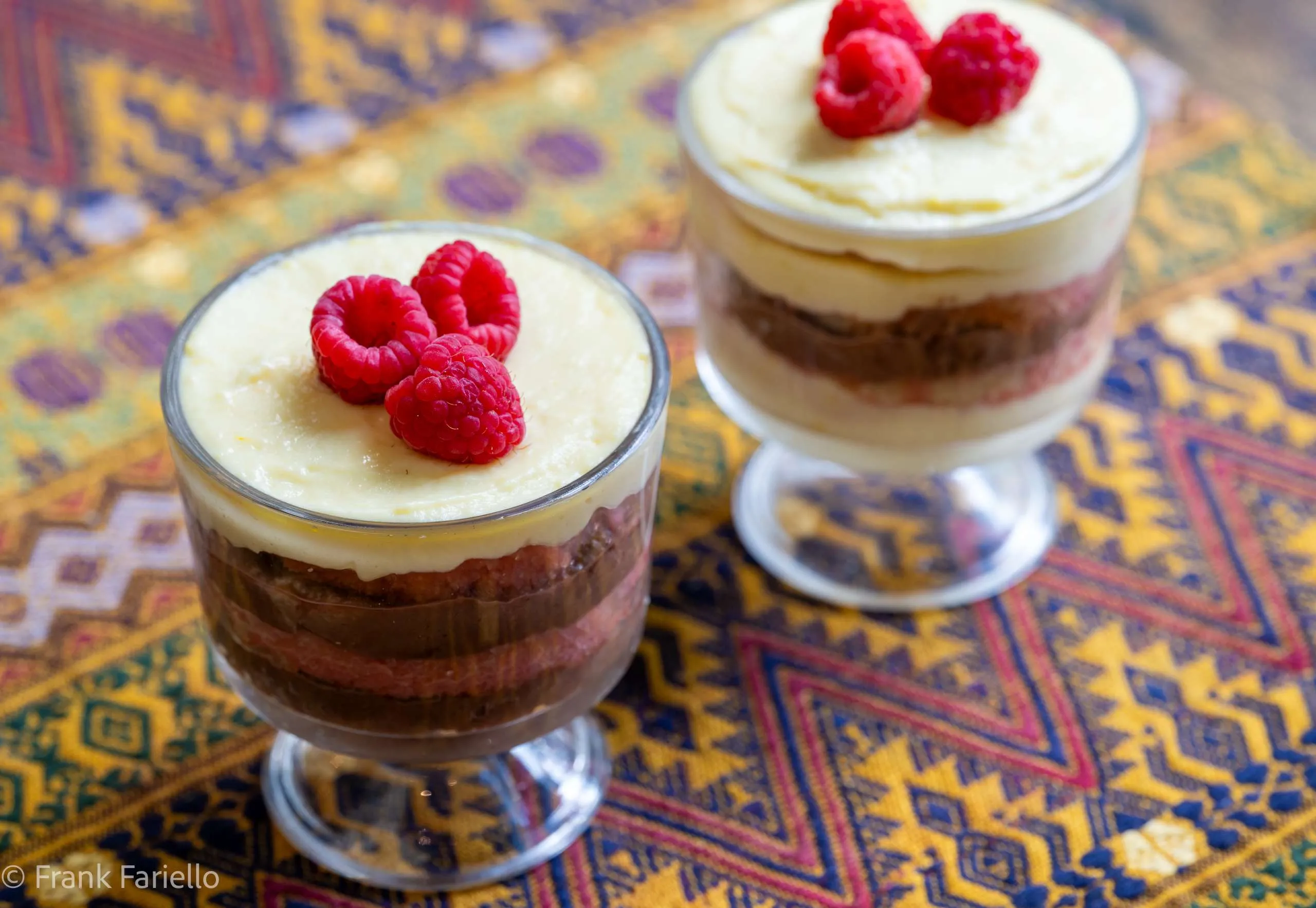
Zuppa inglese, literally meaning ‘English soup’, is neither English nor a soup. It is actually a classic Italian dessert. You’ll find it all across central Italy, from Emilia-Romagna through Tuscany and the Marche down to Rome.
The name is apt nevertheless. Inzuppare means to soak, which is just what you do to the sponge cake at its heart. The result is vaguely reminiscent of the bread-thickened soups called zuppe so typical of the cookery of central Italy, only sweet rather than savory and cold rather than hot. As for the inglese part, the origins of this dish are disputed, but it bears a strong resemblance to—and some say was inspired by—the English trifle. Closer to home, you could think of it as a kind of cousin to the better-known tiramisù, though zuppa inglese is much older and, some say, its ancestor.
Simple to make, but sure to impress
Zuppa inglese is actually quite simple to make, but it makes a great impression. That’s especially true when it’s served in a large glass trifle bowl that shows off its colorful layers. Classic zuppa inglese is made of pan di Spagna (sponge cake) soaked in a red liqueur called alchermes, also spelled alkermes. It alternates with layers of crema pasticcera, or pastry cream: one plain and lemon-scented, the other flavored with chocolate.
The golden and dark layers of crema against the scarlet cake make for a striking dessert. And if you want to gild the proverbial lily, add a topping of cocoa, berries or sliced almonds—or whatever strikes you fancy.
Zuppa inglese is sure to be a big hit. I love it, and I don’t even care that much for sweets. It’s sweet but not cloyingly so, and the alchermes lends it a heady, almost floral perfume, with a whisper of spice. I find the mix of flavors enchanting.
Since one recipe is enough for a crowd, it’s perfect for a dinner party where you want to wow your guests. For a less dramatic but even more elegant presentation, serve it in individual dessert bowls.
Ingredients
Makes enough for a crowd
For the crema pasticcera:
- 8 egg yolks
- 150 g (3/4 cup) sugar
- 75 g (1/2 cup) flour
- 1 liter (4 cups) milk
- Grated zest of 1/2 lemon
- 100 g (3-1/2 oz) dark chocolate, finely chopped or in chips
For assembly:
- 1 kg (2 lbs) sponge cake or pound cake
- About 240 ml (1 cup) alchermes or other liqueur(s) (see Notes)
Optional toppings:
- Cocoa powder
- Berries
- Sour cherries (amarene)
- Sliced almonds
Directions
Make the crema pasticcera
In the bowl of a stand mixer, whisk together the egg yolks and sugar until pale and creamy. The mixture should form ‘ribbons’ as the whisk rotates. Then add the flour slowly, bit by bit, until fully incorporated.
Meanwhile, heat the milk over moderate heat until hot, almost but not quite at the boil. You will see little bubbles just beginning to form around the edge of the pot. Take the milk off the heat and drizzle it, little by little, into the mixer bowl.
Now pour the whole thing back into the pot and put it over very gentle heat. Stir continuously with a whisk or wooden spoon. After a while, it should begin to thicken. Keep stirring until quite thick, making sure the mixture doesn’t come to a boil.
Divide and flavor the crema pasticcera
While the crema is still hot, quickly transfer about half of it to a bowl and stir in the lemon zest.
Add the chopped chocolate to the other half, still in the pot but off heat. Stir until the chocolate has melted completely and the crema is a uniform color. Transfer to another bowl.
Let both creme cool completely.
Mise en place
Pour about a cup of alchermes into a small bowl.
Slice your sponge cake or pound cake into 1 cm (1/2 inch) slices.
Have your two creme at hand in separate bowls, and prepare whatever topping you have in mind.
Assemble the dish
Take a trifle bowl large enough to hold all the ingredients, or individual dessert bowls if you prefer. Cover the bottom with a thin layer of one of the creme.
Make a layer of cake slices, cutting them up if needed to make a complete layer.
Now brush the cake with alchermes. No need to drown it, just enough that the cake takes on the color of the liqueur.
Spread over a layer of the other crema.
Then add another layer of cake, moisten it with alchermes, and spread over a layer of crema.
Repeat, alternating the chocolate and plain creme, until you run out of ingredients or fill your bowl. End with a layer of plain crema.
Let it rest
Place the bowl in the fridge and let it rest for a good few hours (see Making zuppa inglese ahead, below).
Serve
It is best not to serve this dish right out of the fridge. Take it out about 30-60 minutes before serving to let it return almost to room temperature. That way you can better appreciate its flavors.
Just before serving, top with one or more of the toppings if you care to.

Notes on zuppa inglese
As mentioned, zuppa inglese is a pretty simple dessert anyone can make, assuming you use store-bought sponge cake or pound cake.
The only tricky part, really, is thickening the crema pasticcera. You need to heat it slowly enough that you cook the flour, while making sure that the eggs don’t curdle. Stir constantly, scraping the bottom of the pot all over, and keep the mixture below the boil. If at any point you sense that things might be getting out of hand, remove the pot from the heat. Adding a bit of cold milk or cream will cool things off.
About alchermes
Alchermes (or alkermes) is a liqueur made by infusing neutral spirits with sugar, spices, herbs and other flavorings. Its most striking feature is its brilliant scarlet color, which it gets from a rather unusual ingredient, the tiny scale insect called kermes. In fact, its name comes from the Arabic al-qirmiz, the word for kermes. The insect lives on Mediterranean oaks and was crushed for one of the most prized red dyes of the ancient and medieval world.
After the conquest of the Americas, kermes gave way to cochineal. This related insect lives on Mexican cactus and yields an even more brilliant red. Some makers still color their alchermes with cochineal today, though many commercial brands have switched to synthetic dyes.
The history of alchermes
The liqueur itself began as medicine. Its ancestor was the confectio alkermes, a medieval remedy from the Arab world prized as a tonic for the heart. It blended kermes with rose water, cinnamon, ambergris, musk, ground pearls and even gold leaf.
In Florence, the Dominican friars of Santa Maria Novella turned it into a liqueur and sold it as an elixir of long life. Legend has it that Caterina de’ Medici took it to France, where it became known as the liqueur de Médicis. (You have to wonder how big her cortège was, given all the foods and drinks she supposedly brought to France!) The friars’ pharmacy, the Officina Profumo-Farmaceutica di Santa Maria Novella, still makes it, from a recipe first written down in 1743.
Today’s alchermes is made by steeping cinnamon, cloves, nutmeg, cardamom, coriander, vanilla and orange peel in alcohol. It is then sweetened with syrup and perfumed with rose water. The result is syrupy, intensely aromatic and, at 20-30% alcohol, fairly gentle on the tongue. Few people drink it on its own anymore. It lives on mostly in the pastry kitchen, especially in Tuscany and Emilia-Romagna. There it tints and perfumes desserts like zuppa inglese, zuccotto and the peach-shaped pesche di Prato.
Where to buy alchermes
Outside Italy, alchermes used to be nearly impossible to find, but it has become easier to get. Here in North America, I ordered mine online from Dolceterra. Buona Italia carries a traditional Tuscan version colored with cochineal. There is also a domestic option, Heirloom American Alchermes, made by the folks behind Bittercube bitters. It’s available at many liquor stores and online retailers. It’s considerably stronger than the Italian versions, at 40% alcohol, so you may want to go a bit lighter when brushing it on your cake. (Full disclosure: I haven’t tried it, so I can’t vouch for the flavor.)
Elsewhere, readers in Australia are in luck. Nick’s Wine Merchants stocks both Luxardo’s alkermes and the Santa Maria Novella original. Santa Maria Novella also sells it through its Australian online shop. In the UK, it’s harder to track down, it seems. Your best bets are Italian delis and online marketplaces like Amazon UK. Santa Maria Novella’s London shops are also worth a call if you live in the area.
Substitutes for alchermes
Recipes vary on the substitutes they recommend. If color does not matter to you, I rather like amaretto mixed with a bit of rum. Rum alone would also do well. La cucina italiana calls for vin santo, the classic Tuscan dessert wine. I imagine sweet Marsala, while not typical, would also be nice. Marcella Hazan recommends a rather heady mixture of rum, cognac, Drambuie and Cherry Heering.
And for the ambitious, Giuliano Bugialli gives a recipe for homemade alchermes in his classic The Fine Art of Italian Cooking.
About the chocolate and cocoa
For the chocolate crema, use a good dark chocolate rather than milk chocolate, which would make the dessert cloying. Ready made dark chocolate chips are ideal, but if you buy it in bar form, chop it finely so it melts quickly and evenly into the hot crema. For a more intensely chocolatey crema, use a bit more chocolate, or stir in a spoonful of cocoa too.
If you dust the top with cocoa, use unsweetened cocoa powder and go easy. Sift it through a fine sieve so you get a thin, even veil rather than clumps. And do it just before serving, as cocoa darkens and turns blotchy in the fridge. As for which cocoa, Dutch-process cocoa is darker in color and milder in flavor. Natural cocoa is lighter but more bitter, which makes for a nice contrast with the sweet crema and spiced alchermes. Either one works; it’s really a matter of taste.
About the cake
The classic recipe calls for pan di Spagna, a classic Italian sponge cake, light, springy and a bit dry on its own. That’s exactly what makes it so good at soaking up liqueurs and syrups without falling apart. It’s the base of choice for so many Italian layered desserts, from zuppa inglese and zuccotto to Sicilian cassata.
Despite its name, which means ‘Spanish bread’, it’s actually from Genoa. The story goes that in 1749, Giovan Battista Cabona presented the cake at a banquet at the Spanish court. He was chef to the Marquis Domenico Pallavicini, the Genoese ambassador to Madrid. The cake was first called pâte génoise, or ‘Genoese pastry’, and was later renamed in honor of its hosts. Its French counterpart, the génoise, still bears the name of its hometown.
How to make pan di Spagna at home
Pan di Spagna can be a bit tricky to find in stores outside Italy. Luckily, it’s easy enough to make at home. It calls for just eggs, sugar and flour: no butter and, traditionally, no baking powder. All its rise comes from the air beaten into the eggs.
- Beat 6 eggs with 180 g (a scant cup) of sugar for 15 minutes, until pale, thick and tripled in volume.
- Gently fold in 180 g (1-1/2 cups) of sifted flour, a little at a time, so the batter doesn’t deflate. For a more tender crumb, use half flour and half potato starch.
- Pour into a buttered and floured 24 cm (9-1/2 inch) springform pan. Bake at 170°C (340°F) for about 40 minutes, until golden and a toothpick comes out clean. Don’t open the oven door for the first 30 minutes.
- Let it cool completely. Ideally, make it the day before, as it slices more cleanly once it has rested. For this recipe, you’ll want two cakes.
Alternatives
If you can’t find sponge cake and would rather not make it, a fairly light, fluffy pound cake will do. These days you’ll often see zuppa inglese made with savoiardi, or ladyfingers, which brings it even closer to tiramisù.
Presentation
In some versions, zuppa inglese is made in a bowl that you line entirely with liqueur-laced cake. To serve, the bowl is inverted onto a plate, creating a ‘dome’ much like the Tuscan zuccotto.
Personally, I prefer the version given here, which is much easier. (No risk of accidents!) And to my mind, it’s even prettier in a glass trifle bowl that shows off the alternating layers. For an even more elegant presentation, make individual portions in dessert bowls, as pictured here, or in fluted tulip bowls.
Variations
Chocolate was most likely a later addition to zuppa inglese, and some older recipes call for plain crema pasticcera alone. This simpler version lets the scarlet of the alchermes stand out even more. To try it, leave out the chocolate and use plain crema throughout. A light dusting of cocoa between the layers is a nice touch.
If you want a gentler taste, you can dilute the alchermes with water or, for a sweeter version, simple syrup.
Ada Boni’s 1920 ‘Roman’ version is a richer affair. The sponge cake is dipped in rum and in a cocoa cream, then layered with crema pasticcera and candied fruit and topped with meringue.
In Naples, zuppa inglese takes a rather different form. Instead of alchermes, the pan di Spagna is soaked in a rum-spiked syrup. It’s layered with crema scented with lemon and vanilla and studded with dark chocolate and amarene, sour cherries in syrup. Like Ada Boni’s Roman version, it is crowned with meringue. The whole thing is shaped into a dome, covered with meringue and dried in a low oven, then decorated with candied fruit.
You’ll also come across modern versions soaked in limoncello, often paired with a lemon-scented crema and fresh berries. It’s not traditional, as far as I can tell, but it makes a lovely, summery alternative, especially if you can’t find alchermes.
The disputed origins of zuppa inglese
The origins of zuppa inglese, as mentioned, are in some dispute. But according to the two most common stories, it is a recreation of the English trifle.
One story has it that the dish originated in 19th-century Tuscany. At the time, Florence was home to a large English expatriate community. Think A Room with a View. The story goes that zuppa inglese was the result when by the Italian cook of an English family in Fiesole, outside Florence, attempted to recreate the trifle. Another story has it that a 16th-century Duke of Este visited the Elizabethan court. Back home, he had his cooks recreate the trifle he had tasted there.
Giuliano Bugialli contests both accounts. He says the name refers to the red color of alchermes, which reminded people of the red in the English flag.
Naples, for its part, has its own story. The dessert was supposedly improvised from leftover cake, rum and custard for King Ferdinand’s banquet in honor of Admiral Nelson. Hence the ‘English’.
Personally, for what it’s worth, I tend to believe the first story—or something like it—is the most likely to be true. For one thing, the trifle did not take its current form until at least the 17th century.
Zuppa inglese and tiramisù
As for its relationship to tiramisù, the family resemblance is obvious. Both are layers of soaked cake or biscuits and cream, finished with cocoa. And zuppa inglese is clearly the older of the two, by a century at least. Pellegrino Artusi was already including it in his 1891 cookbook. Tiramisù only appeared in the late 1960s, most likely at the restaurant Le Beccherie in Treviso, though Friuli disputes the claim.
So it’s tempting to see tiramisù as a modern update of zuppa inglese. Savoiardi replace the sponge cake, coffee the alchermes and mascarpone the crema pasticcera. But the evidence for a direct line is thin. The tiramisù cream seems to descend instead from sbatudìn, egg yolks beaten with sugar. Families in the Veneto gave it as a pick-me-up, hence the name tirami sù. Cousins, then, rather than parent and child.
Making zuppa inglese ahead
Zuppa inglese not only can but should be made ahead. Some recipes call for as little as an hour of resting and others as much as a whole day. To my mind, 2-3 hours is probably the minimum. That allows the flavors to meld and the crema and cake layers to adhere properly.
Like tiramisù, the dish will change in texture the longer it rests, getting softer over time. It’s a matter of taste, really, at what point it is at its best.
Post scriptum
Regular readers may remember that I first posted my recipe for zuppa inglese way back in 2012. At the time I had to make do without the genuine article, since alchermes was all but impossible to find here. Well, I finally laid my hands on a bottle, and it seemed high time to revisit this classic, with some fresh photos to boot!

Zuppa inglese
Ingredients
For the crema pasticcera:
- 8 egg yolks
- 150 g granulated sugar
- 75 g flour
- 1 liter whole milk
- Grated zest of 1/2 lemon
- 100 g dark chocolate, finely chopped or in chips
For assembly:
- 1 kg sponge cake or pound cake
- 240 ml alchermes or other liqueur(s) (see Notes)
Optional toppings:
- Cocoa powder
- Berries
- Sour cherries amarene
- Sliced almonds
Instructions
Make the crema pasticcera
- In the bowl of a stand mixer, whisk together the egg yolks and sugar until pale and creamy. The mixture should form ‘ribbons’ as the whisk rotates. Then add the flour slowly, bit by bit, until fully incorporated.
- Meanwhile, heat the milk over moderate heat until hot, almost but not quite at the boil. You will see little bubbles just beginning to form around the edge of the pot. Take the milk off the heat and drizzle it, little by little, into the mixer bowl.
- Now pour the whole thing back into the pot and put it over very gentle heat. Stir continuously with a whisk or wooden spoon. After a while, it should begin to thicken. Keep stirring until quite thick, making sure the mixture doesn’t come to a boil.
Divide and flavor the crema pasticcera
- While the crema is still hot, quickly transfer about half of it to a bowl and stir in the lemon zest.
- Add the chopped chocolate to the other half, still in the pot but off heat. Stir until the chocolate has melted completely and the crema is a uniform color. Transfer to another bowl.
- Let both creme cool completely.
Mise en place
- Pour about a cup of alchermes into a small bowl.
- Slice your sponge cake or pound cake into 1 cm (1/2 inch) slices.
- Have your two creme at hand in separate bowls, and prepare whatever topping you have in mind.
Assemble the dish
- Take a trifle bowl large enough to hold all the ingredients, or individual dessert bowls if you prefer. Cover the bottom with a thin layer of one of the creme.
- Make a layer of cake slices, cutting them up if needed to make a complete layer.
- Now brush the cake with alchermes. No need to drown it, just enough that the cake takes on the color of the liqueur.
- Spread over a layer of the other crema.
- Then add another layer of cake, moisten it with alchermes, and spread over a layer of crema.
- Repeat, alternating the chocolate and plain creme, until you run out of ingredients or fill your bowl. End with a layer of plain crema.
Let it rest
- Place the bowl in the fridge and let it rest for a good few hours (see Making zuppa inglese ahead, below).
Serve
- It is best not to serve this dish right out of the fridge. Take it out about 30-60 minutes before serving to let it return almost to room temperature. That way you can better appreciate its flavors.
- Just before serving, top with one or more of the toppings if you care to.
Nutrition
Discover more from Memorie di Angelina
Subscribe to get the latest posts sent to your email.


I love how this recipe takes the simple flavours of a classic Caprese salad and turns them into a warm, comforting appetiser. The combination of fresh tomatoes, basil, olive oil and plenty of melted cheese sounds delicious, and that memory of enjoying freshly made mozzarella in Capri makes it even more special. I can imagine serving this with toasted bread for sharing, especially when entertaining friends.
This is an incredible dessert. It would be perfect after a light meal.
Indeed it would!
As you know, I am a big fan of zuppa inglese, though without the chocolate. I really think it is the alchermes that makes the dish! This is perfect timing for holiday planning…
The version without chocolate is amazing. And, in fact, it’s probably the original recipe. I toyed with making that the main recipe but since a mixed filling has become the standard I opted not to. But for sure alchermes makes the dish!
They look lovely Frank! We tried our first one in Rome recently and it was rather wet! Talk about disappointed after reading about this dessert all these years! I’m sure yours is amazing!
Too bad about that wet zuppa inglese! Sounds like they took the name literally, lol.
Ha, ha! I guess they did!!!
I love trifle and your Zuppa inglese sounds delicious! I wonder if the name might also have something to do with the French name for custard – Crème anglaise.
I will have to look out for some alchermes.
Interesting. I’ll have to look into that. Good luck in your search for alchermes!
They do look very pretty and remind me of tiramisu with fruit version.
Thanks, Angie! There’s definitely a family resemblance there though this is actually centuries older than tiramisù.