


Poor cucuzza. This Rodney Dangerfield of the vegetable world gets no respect. An extravagantly long and slender summer squash typical of Sicily, it’s the butt of endless jokes. Like the local proverb I learned last time I was there for a family wedding: condiscila come vuoi, è sempre cucuzza! Or in the original Sicilian: Cònzala comu vo’ ca sempri cucuzza è. Roughly translated, it means ‘dress it up however you like, it’s still cucuzza!’ Said of ugly truths that, as much as you try to pretend otherwise, can’t be remedied. Something like our expression ‘putting lipstick on a pig’.
The proverb is a bit unfair. It’s true that summer squashes in general don’t have a lot of intrinsic taste. But if you do dress them up, they can be quite tasty. I can think of no better example than pasta con i tenerumi, a soup of pasta with cucuzza coupled with its tender shoots and leaves called tenerumi, which give the dish its name.
Not quite a soup…
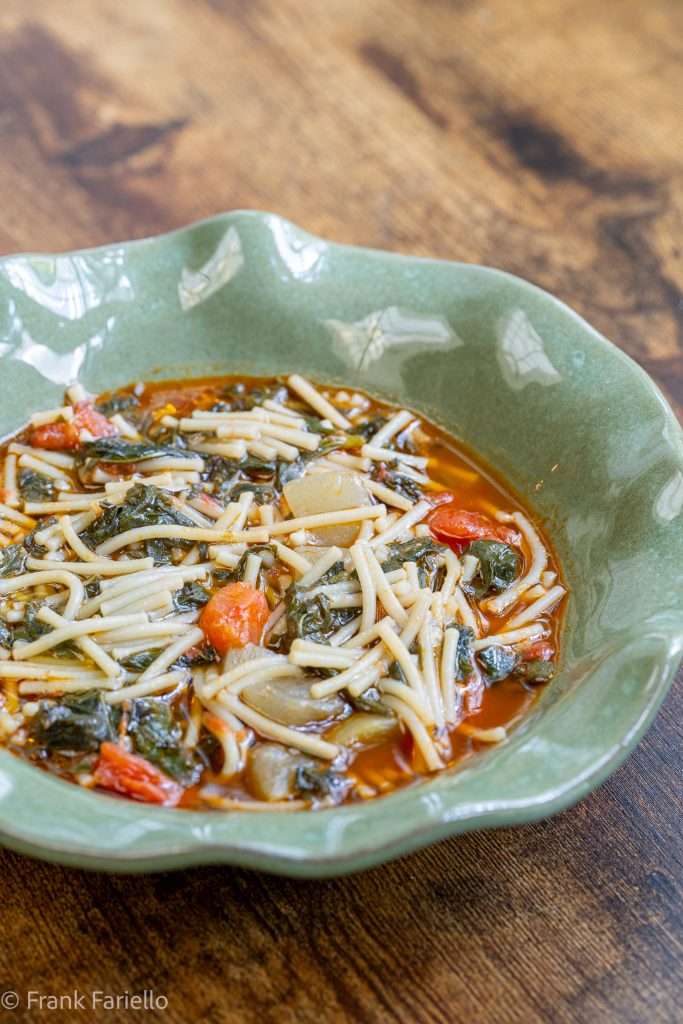
A summer soup may seem like a oxymoron, but this one makes perfect sense. It’s actually inhabits a middle ground between a proper pasta and a soup. And it’s usually served only slightly warm or even room temperature. Like so many summer dishes, the recipe is fairly care-free, requiring only about 15 minutes over the stove. You simmer cucuzza and tenerumi in water to cover, add broken up spaghetti to cook until it’s al dente, then finish with a quick fresh tomato sauce popularly called picchi-pacchi, which you’ve made separately while the vegetables and pasta are cooking. And done!
The main challenge in making pasta con i tenerumi is finding its star vegetable. Here in North America cucuzza was actually pretty popular among the Italian diaspora back in the day, especially those of Sicilian descent of course. Today it’s nearly vanished from our markets. And tenerumi are even harder to find. But there are some decent substitutions you can make for both, which I explain in the Notes below. It may not taste quite like the original, but it’s delicious all the same.
Ingredients
- 500g (1 lb)1 tenerumi, trimmed of its tough stems and roughly chopped
- 250g (1/2 lb) cucuzza squash, peeled and cubed
- 150 g (5 oz) spaghetti, broken into short lengths
- 500g (1 lb) tomatoes, peeled and cut into chunks
- 1-2 cloves garlic, peeled and chopped
- olive oil
- salt
Directions
In a large pot, bring 2 liters (2 quarts) of lightly salted water to a simmer. Add the tenerumi and cucuzza and simmer for 10 minutes, or until nearly tender.
Add the spaghetti and let it cook until al dente. Top up with additional hot water as and if needed.
In the parallel with the above steps, sauté the chopped garlic in abundant olive oil in a skillet over a gentle flame. As soon as you can smell the aroma of the garlic, add the tomato and a good pinch of salt. Simmer gently until well reduce.
When the pasta is nearly al dente, pour the tomato sauce into the large pot with the pasta and greens. Simmer everything together for a minute or so to let the flavors meld, then turn off the heat.
Allow to cool for at least a few minutes. Serve slightly warm or at room temperature, drizzled with fruity olive oil.
Notes on pasta con i tenerumi
As you’ve seen, the recipe is a simple one, but it does require a little prep work to begin with. You need to trim the tenerumi leaves of their tough stems; you can use a bit of any slender stems at their base, as well as any tendrils and blossoms. Then wash them in several changes of water to remove any grit and chop them roughly. The cucuzza should be peeled, then cut into chunks or cubes.
Peeling the tomatoes isn’t a must, but it eliminates any unpleasant bits of skin getting stuck between your teeth. As always, look for fully mature and flavorful tomatoes suitable for a quick sauce. You just plunge the tomatoes into boiling water for 30 seconds—you can use the same pot you’re using for the soup—and rinse them under cold water. After that, the skins should come off easily. You could also use canned tomatoes, if you don’t have access to good quality fresh ones.
Sourcing tenerumi
This is the main challenge in making this dish outside its native turf, as tenerumi are very difficult, well night impossible in fact, to find. At least where I live. I understand that you can sometimes find squash leaves in Asian markets, so you can look for them there.
Otherwise, there are substitutes. The best ones, in my opinion, are also to be found in Asian markets. Perhaps closest to tenerumi are yam shoots or leaves, which you can find in Asian supermakets in the summer. Also not a bad substitute would be water spinach, not actually spinach but ipomoea aquatica, a hollow stemmed leafy green vegetable widely used in Asian cooking, It goes by the names kangkong in the Philippines and Malaysia, ong choy or water morning glory in Chinese cooking, rau muống in Vietnamese. Chayote shoots, which you might find in Latino markets, also work well.
In a more Western vein, you could use another delicate leafy vegetable like baby spinach, which you can leave untrimmed, or Swiss chard, trimmed of its thick stem. Of course, if you can find zucchini shoots and leaves in local markets (or grow your own zucchini) they make a fine substitution as well.
Sourcing cucuzza

Cucuzza is the lagenaria siceraria, a bottle squash native to Sicily. As mentioned at the top, it is a long and slender, pale green bottle gourd. If left to its own devices, it can grow to truly prodigious lengths, as shown at left.
If you live in an area with a large Italian (and especially Sicilian) population, you may be able to find cucuzza in your local markets. In North America, Melissa’s Produce sells it online. Otherwise, it can be hard to find. In my area, Asian markets carry opo squash, also sometimes called Chinese long squash, which is rather thicker and not as long as cucuzza, but botanically it’s the same plant, so it makes a perfect substitute. Aside from peeling, it usually has a foamy core that you should scoop out.
If you can’t find cucuzza or long squash, then you could use zucchini. In fact, there are versions of the dish that call for it. Or just omit it altogether, as some versions of the dish do.
Variations
The main variations in the recipe for pasta con i tenerumi are:
- In bianco o in rosso. The oldest versions of pasta con i tenerumi didn’t include tomato, but today tomato is de rigueur, in particular in Palermo. Elsewhere it is sometimes omitted. Some versions include more or less tomato than given in the recipe above. Some recipes call for cherry tomatoes, which you obviously don’t need to peel (!)
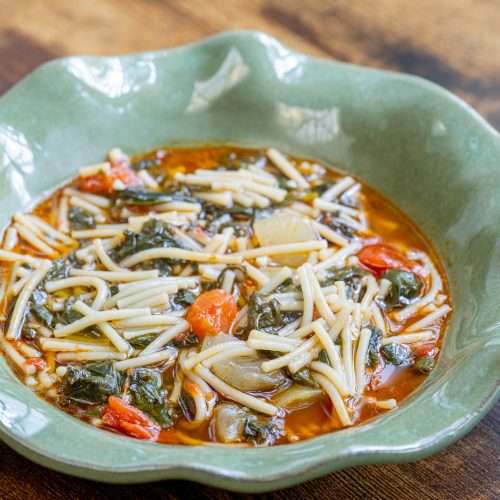
- Dry or wet. Pasta con i tenerumi can be ‘dry’—more of a proper pasta with a vegetable dressing— or ‘wet’—an actual soup—or somewhere in between, depending on how much water you add to the pot. Palermo tends to favor brothier versions while in the interior regions of Sicily the dish is drier. Personally I prefer it somewhere in between a proper soup and a pastasciutta as shown in the photos.
Other variations
Some versions of pasta con i tenerumi call for cheese. Personally I find this soup is plenty tasty without it, but many recipes call for topping the finished soup with grated pecorino or ricotta salata, or adding small cubes of caciocavallo to the pot just before serving, allowing it to melt partially.
Although broken spaghetti is emblematic of the dish, some versions use a short pasta like ditalini or even pasta mista, mix of different leftover pasta shapes.
Other optional additions include a pinch of hot red pepper, for those who like it spicy, and potatoes, which add bulk and thicken it into something almost resembling a minestrone.
In term of method, the main variation lies in whether, as in this recipe, you make the picchi-pacchi sauce separately. In some versions, you make the dish in a single pot, starting with the garlic and oil, then adding the tomatoes, and when they have nicely reduced, adding the vegetables and water to cover, then finally the pasta. This one pot method avoids dirtying an extra pot and the need to juggle two cooking processes at once. But that said, I don’t find the result quite as satisfying.
Make pasta con i tenerumi ahead
A bit like a past or rice salad, you can make this dish entirely ahead and serve it at room temperature. In that case, I’d make sure that the pasta is very al dente, as they will continue to cook as the dish rests. The pasta will also absorb more liquid as it cools, so depending on whether you like it ‘dry’ or ‘wet’, you may want to make it brothier to start.
1 The weight given is for untrimmed shoots and stems.
Pasta con i tenerumi
Ingredients
- 500 g tenerumi, trimmed of its tough stems and roughly chopped
- 250 g cucuzza squash, peeled and cubed
- 150 g spaghetti, broken into short lengths
- 500 g tomatoes, peeled and cut into chunks
- 1-2 cloves garlic peeled and chopped
- olive oil
- salt
Instructions
- In a large pot, bring 2 liters (2 quarts) of lightly salted water to a simmer. Add the tenerumi and cucuzza and simmer for 10 minutes, or until nearly tender.
- Add the spaghetti and let it cook until al dente. Top up with additional hot water as and if needed.
- In the parallel with the above steps, sauté the chopped garlic in abundant olive oil in a skillet over a gentle flame. As soon as you can smell the aroma of the garlic, add the tomato and a good pinch of salt. Simmer gently until well reduce.
- When the pasta is nearly al dente, pour the tomato sauce into the large pot with the pasta and greens. Simmer everything together for a minute or so to let the flavors meld, then turn off the heat.
- Allow to cool for at least a few minutes. Serve slightly warm or at room temperature, drizzled with olive oil.
Notes
Nutrition
Discover more from Memorie di Angelina
Subscribe to get the latest posts sent to your email.




Something is wrong with your feed as I haven’t received any update from you since July…
The pasta looks very tasty!
Oh hear! Sorry to hear it. I changed website hosts in July, maybe that’s the issue. Are you using an RSS feed? You may need to resubscribe.
Well you learn something new every day Frank. Cucuzza squash. I’ve never heard of it and never seen it. Glad you included that picture. And I bet this is a delicious recipe regardless of how it looks or what its made with!
Indeed it’s very forgiving. Thanks for stopping by, Neil!
I have definitely seen cucuzza in the markets in Sicily and perhaps elsewhere. You can’t “unsee” it once it’s been espied. But the tenerumi? I don’t think I have ever seen them. Looks like a beautiful dish for comfort. By the way, I hope no one as saying that of the bride at your family wedding!
Indeed! Cucuzza makes quite an impression! If you were in Sicily in the summer, I bet you say tenerumi too but took them for some other leafy veg. And no, I can’t recall what the context was for the proverb, but it definitely wasn’t about the bride; it was the proud mother of the bride who said it!
Fascinating! I’m glad you included a photo of this squash. Such a simple recipe.
A picture says a 1000 words, as the old saying goes…
I think I’ve seen cucuzza, or something like them in the market. I assumed they were a pale coloured zucchini or cucumber. I will have to go and look for them, or use zucchini, which are incredibly cheap at present. In Galicia they cook turnip leaves, which might make a good substitute for tenerumi.
Well, they are a summer squash so in a sense they are just pale zucchini, albeit much longer…! And yes I bet turnip leaves would make an excellent substitute.