

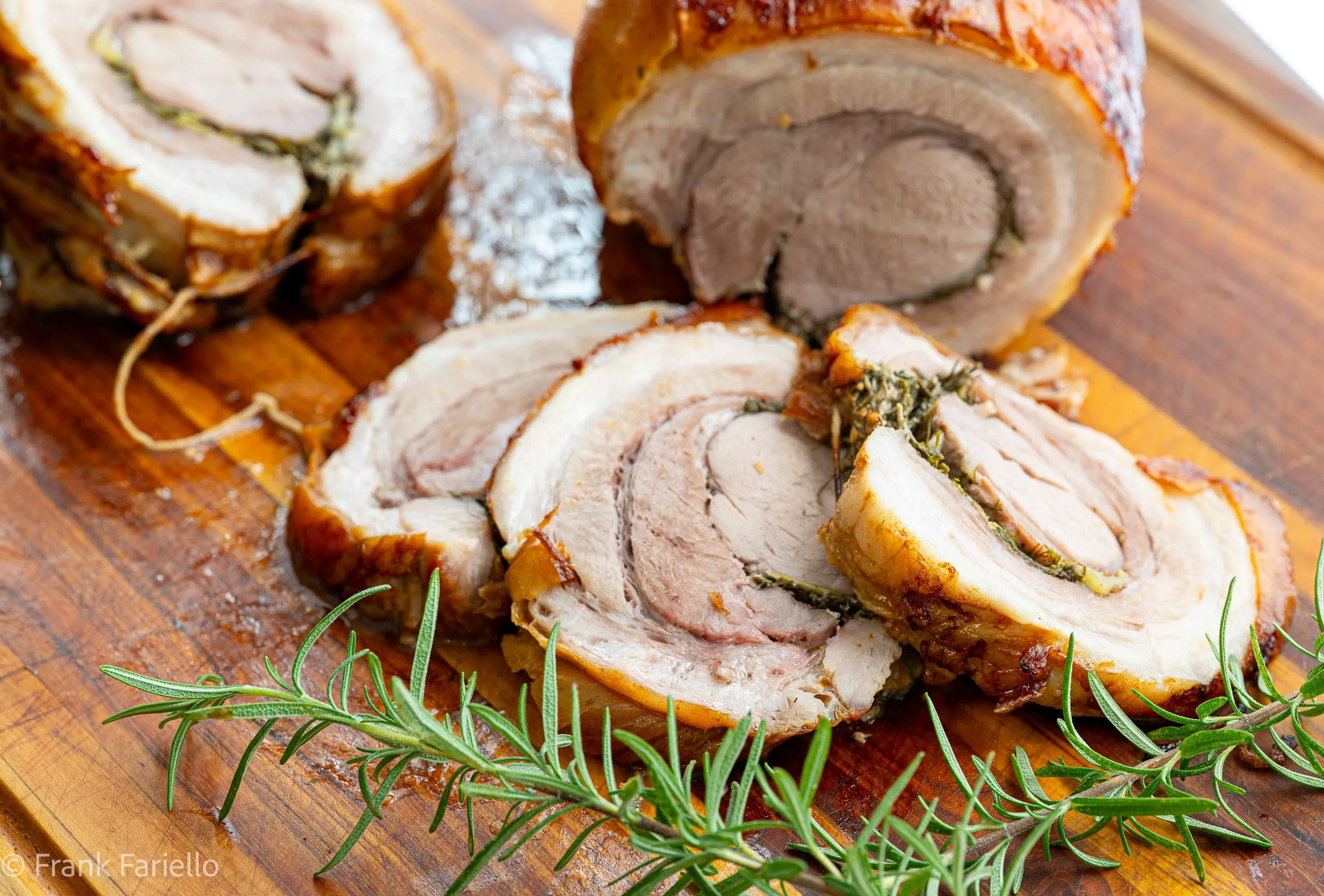
To my mind, the absolute apotheosis of Roman street food is the whole roast pig called porchetta. With its deep golden brown, crackling skin and meltingly tender meat redolent with garlic and herbs, it’s one of the most delicious ways imaginable to enjoy pork.
Porchetta has been enjoyed since ancient times, when it was quite literally food for emperors. It was said to be Emperor Nero’s favorite dish. But it actually predates even the Romans, with origins in Etruscan civilization.
Back when I was living in Rome, I could find porchetta easily at stalls around town, served as a sandwich. For a special treat, I would head up to nearby town of Ariccia in the Alban Hills, where the area’s best porchetta is made. (Porchetta is made elsewhere in Italy, most notably in Abruzzo and Umbria, as well, but I’m less familiar with those versions.)
Making porchetta at home
These days, alas, a juicy porchetta sandwich is no longer right waiting around the corner. Sure, I can buy a cold cut they market as ‘porchetta’ where I live now, but it pales in comparison with the real thing. Fortunately, though, for us unlucky folks who live far from the Eternal City, we can make a kind of mini porchetta at home.
Homemade porchetta is definitely a project, but it’s not really hard to make. Instead of roasting a whole pig, you take a piece of pork belly and a pork tenderloin, season them generously with salt, pepper, garlic and herbs, roll and truss them up, then roast the roll in the oven.
Porchetta something you make for a crowd, as even a smaller pork belly will weigh about 2-3 kilos (6 lbs) or more, but you can consume the leftovers for days afterwards. And porchetta freezes well, so you can cut yours up and defrost it as needed.
Ingredients
- 1 pork belly (about 3 kilos/6-7 lbs)
- 1 pork tenderloin
For the rub:
- white wine
For the herb filling:
- 3-4 clove of garlic, peeled and sliced or chopped
- the fronds from one fennel bulb
- 2-3 sprigs of rosemary, leaves only
- 2-3 sprigs of sage, leaves only
- a few bay leaves
- freshly ground black pepper
- salt
For roasting:
- white wine
- water
Directions
Prepping the porchetta
Rub the pork belly all over with white wine. Use as much as you need to moisten the surface without getting it dripping wet. Do the same with the pork tenderloin.
Lay the pork belly skin side down on a flat surface, with the tenderloin down the middle. If the tenderloin is longer than the belly is wide, trim off the excess. Sprinkle both very generously with salt and freshly ground black pepper.
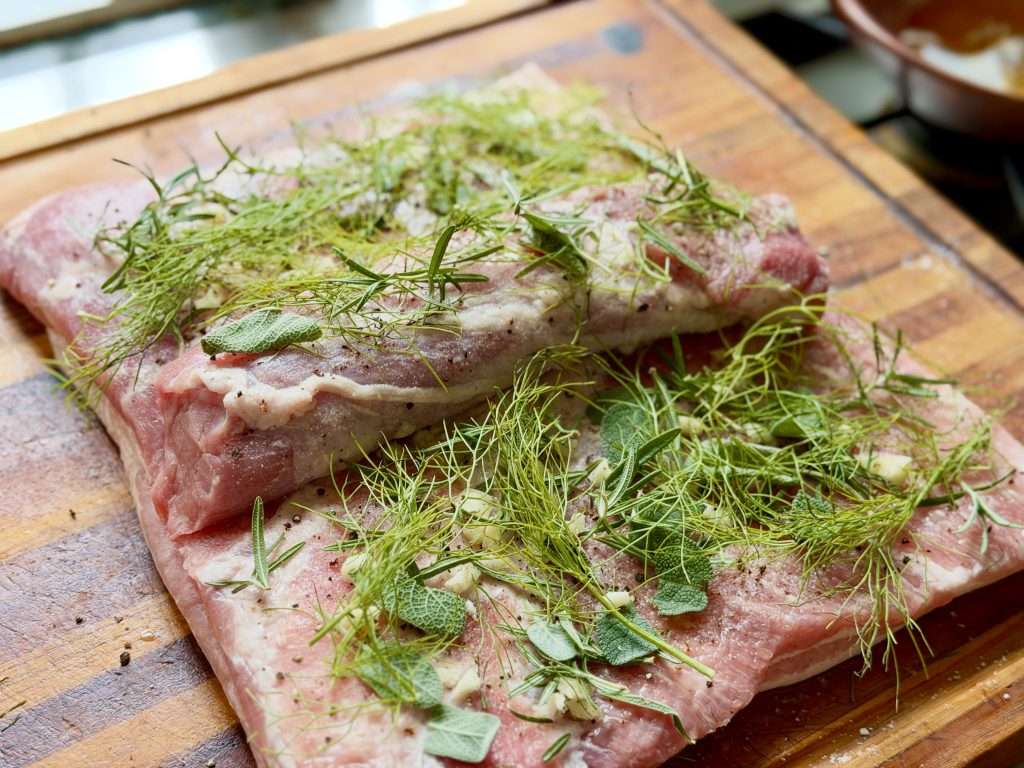
Now scatter the garlic all over the surface of meat, followed by the other filling ingredients so that the whole surface of the meat is well covered with herbs, like so:
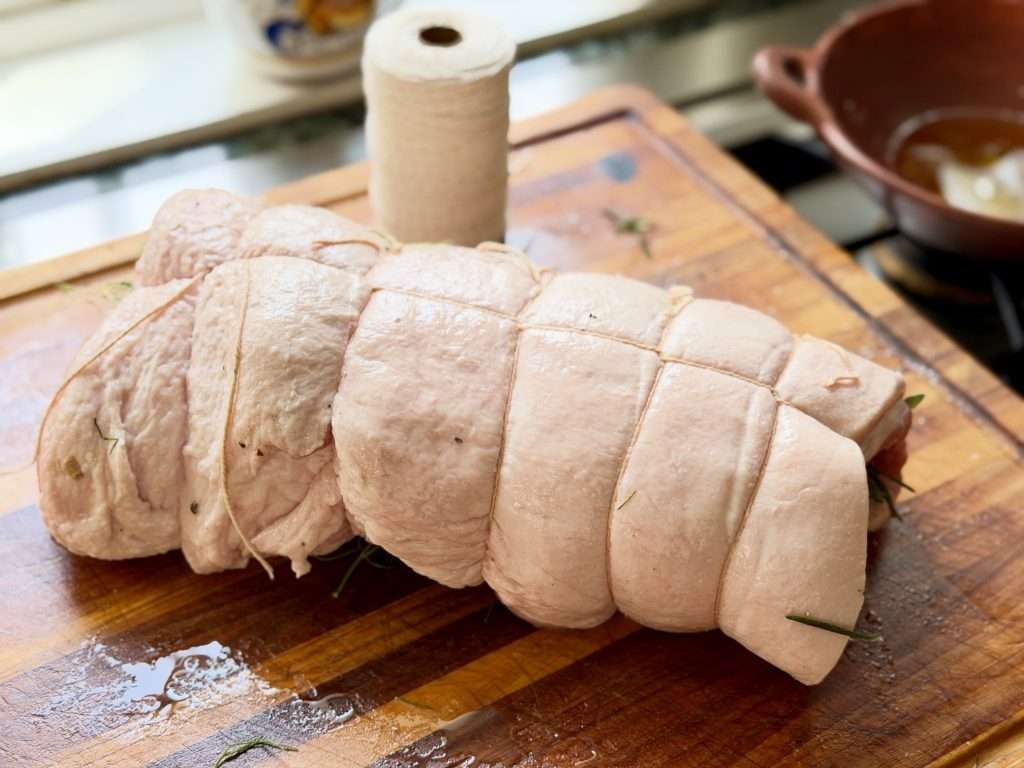
Roll the pork belly around the tenderloin, then truss it as tightly as you can manage, like so:
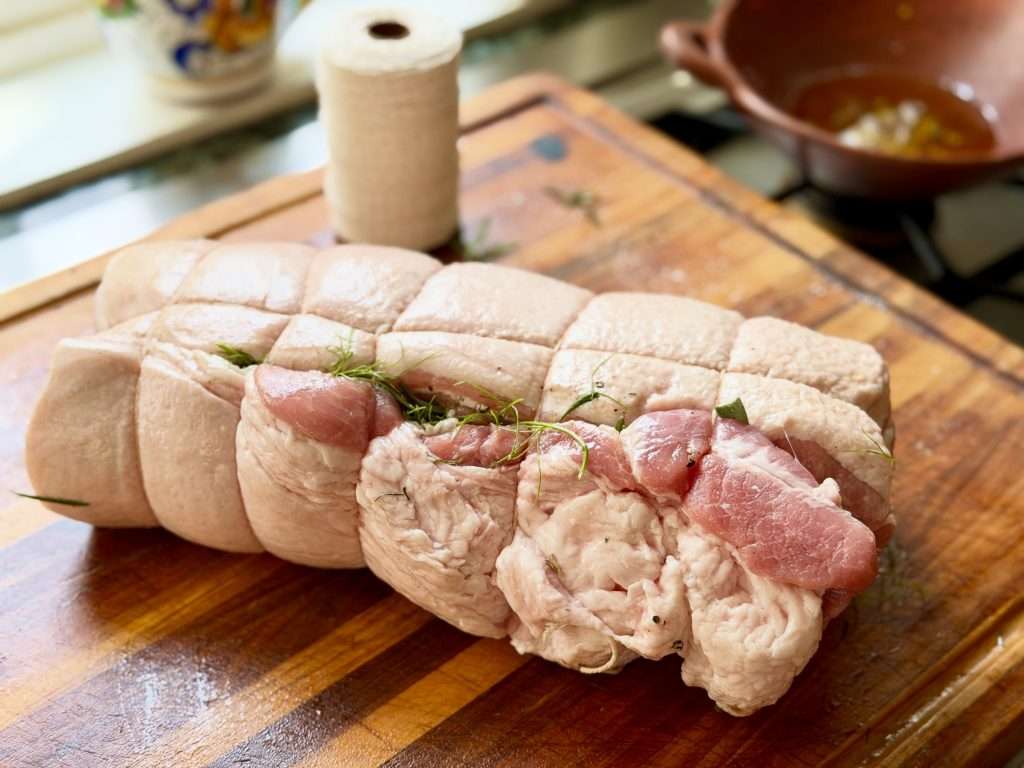
The ends of the pork belly should meet, totally encompassing the tenderloin, like this:
For details on trussing, see the Notes below.
Resting the porchetta
Set the porchetta on a baking sheet and leave it, uncovered, in the fridge at least overnight, up to two days.
Roasting the porchetta
Remove the porchetta from the fridge and let it come back to room temperature (about 1-2 hours, depending on its size).
Place the porchetta on a rack in a roasting pan. Add a glassful of wine (or a mixture of water and wine) in the bottom of the pan.
Roast in a low (150C/300F) oven until you reach an internal temperature of 70C/160F, usually about 2-1/2 hours. Convection is useful to help brown the skin but not essential. If you have a temperature probe, place it in the thickest part of the roast.
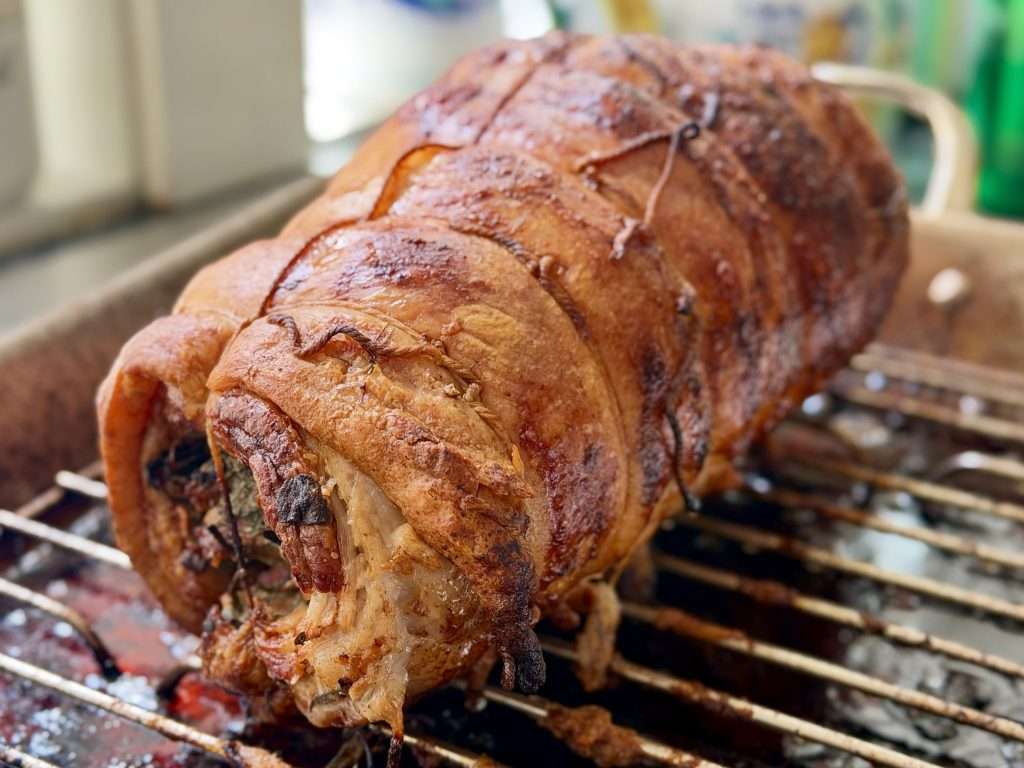
Remove the porchetta from the oven. Raise the oven temperature to 250C/475F. Use convection if you have it. Pour a small glassful of water over the roast, then place in the oven. Roast for about 30 minutes, or until the skin is a deep golden brown and well blistered, as pictured above.
Check on the porchetta frequently after about 20 minutes, to make sure it doesn’t burn.
Serving the porchetta
Let the porchetta rest for at least 20 minutes before serving.
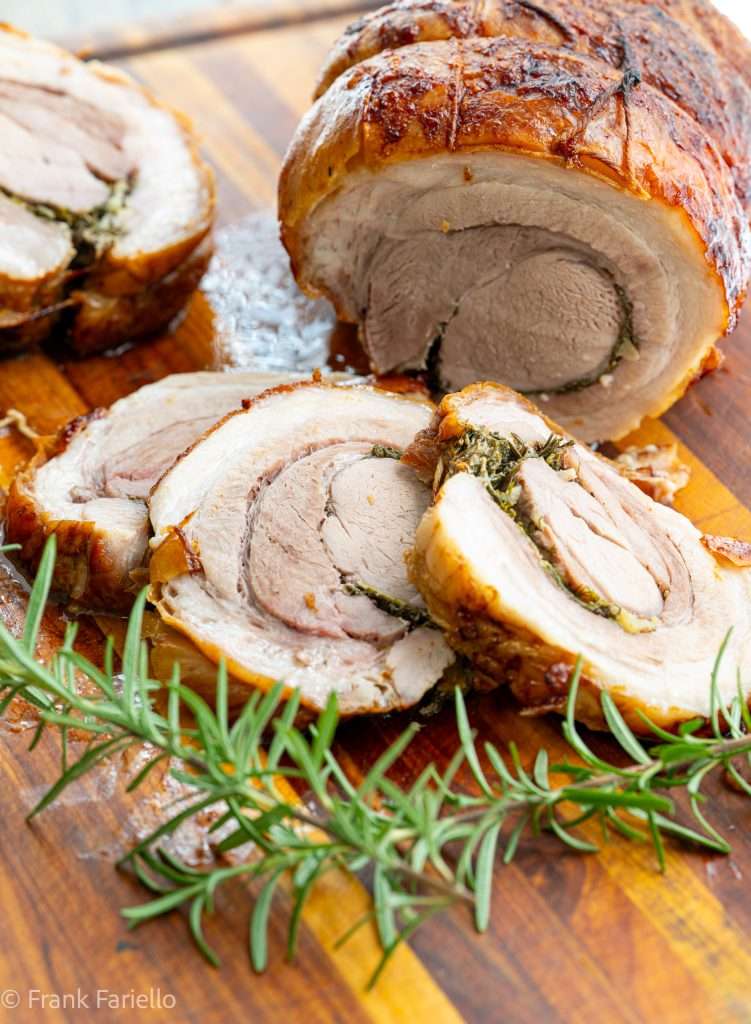
Serve warm or at room temperature. Slice thin as a sandwich filling or thick to serve as a main course.
Notes on porchetta
Choosing the pork cuts
The pork belly is a must. Some recipes omit the tenderloin, but I think it’s also almost a must. The OG version is made with a whole pig, so a homemade porchetta mimics this by wrapping the pork belly around a tenderloin, and sometimes more than one.
Pork belly alone makes for a very rich—and for me rather too rich—porchetta. But it does eliminate a dilemma, as the tenderloin cooks much faster than the belly. (More on this below under Roasting.)
While tenderloin is easily found where I live in, pork belly is not. There’s only one mainstream supermarket that carries it. Once again, however, “ethnic” supermarkets are your friend, in particular Asian ones. Otherwise, here in North America online sources such as Snake River, D’Artagnan and Crowd Cow all carry it, albeit at rather exorbitant prices.
Filling the porchetta
I’ve provided measurements for the first timer, but you should feel free to adjust everything according to your taste. But do be generous with the seasonings, especially the salt. They’re what give the porchetta its characteristic flavor.
If you prefer, you can use dried herbs rather than fresh. That’s what they do in Ariccia—see the demo video—but they start start with their own fresh ingredients and dry them themselves, ensuring their quality. For us home cooks, it’s more practical just to use fresh. And much tastier than any dried herbs you can find in stores.
Trussing the porchetta
Trussing the porchetta is a bit of a chore, but actually quite easy to do. You need sturdy cotton twine, not the thin variety you might use for a chicken or say, a braciole alla napoletana.
Just tie loops of twine around the rolled up porchetta at intervals of about 3cm (1 inch) down its length, making sure to get as close to the edges as you can. Once that’s done, I also like make a long loop down the entire length of the porchetta and across the ends. This helps keep the filling in, and prevents the sides splaying outward. (Or at least it reduces it.)
The key thing in trussing is to make sure the loops are as tight as you can manage. It’s important to keep that pork belly in place and help the porchetta maintain its cylindrical shape.
Resting the porchetta
A word to the wise: don’t skip this step. It’s important not only to allow the herbs and spices to penetrate the meat, but it also helps the roll to compose itself, so to speak.
If you’re in aa rush, you can speed up the process a bit by freezing it for an hour. That helps with the consistency but it’s not enough time to allow for the flavor to develop.
Roasting the porchetta
Pork belly should be well done, reaching an internal temperature of 73C/165F, to achieve the right consistency. An underdone pork belly will be tough and chewy, and you want it to be meltingly soft. The longer roast gives the fat time to render and for the pork skin to crisp up nicely, even before the final blast of heat. You should, however, end the intial slow roast a few degrees below that target temperature, since it will continue to rise in the final high heat finish and even further as it rests.
The downside of this approach is that the tenderloin tends to overcook. One way around this is to roast the porchetta to a lower internal temperature, say 65-68C/150F, but this risks the pork belly being underdone. Personally I can live with slightly overdone center, as the fat of the pork belly keeps things quite juicy.
Roasting temperatures vary quite a bit. Some recipes have you begin high then lower the roasting temperatures after an hour or so, while others call for high roasting temperatures throughout, more like 180C/350F or even 200C/400F or more, for the entire roasting time. I haven’t tested all these variations, but I find the ‘reverse sear’ method given here works very well, ensuring the pork cooks inside and gives you total control on how crispy the skin gets.
Crisping the skin
A crisp skin is the very soul of porchetta, and it’s important to get it right: Nice and crisp but not hard. To achieve that perfect skin, it’s important to let it brown to the point where the skin blisters, this will break up the skin a bit so it’s easy to cut (and chew).
Some recipes have you score the skin even before you start the initial roast—though others scorn that approach as unauthentic. Another tack has you prick the skin after the initial roast and before returning the porchetta to the oven for its final browing. Yet another has you pour some water over the porchetta, which encourages blistering.
Variations
I’ve already covered some of the variations above, including the use of tenderloin or not, using dried rather fresh herbs, and roasting temperatures. Other variations you’ll see in recipes for homemade porchetta include:
- The herbs in the filling can vary a bit. Every recipes I’ve seen calls for garlic, rosemary and fennel, salt and pepper. But not all have sage and bay leaf. Some recipes call for granulated garlic rather than fresh, for a more garlic forward taste. Some call for paprika or hot red pepper flakes for a bit of spice–not something I’ve seen in any Italian language recipe.
- Some non-Italian recipes call for fennel pollen, I suppose as a substitute for wild fennel, but I find fennel fronds work perfectly well. They’re easy to find so you have one less specialty item to search out. But if you wanted a more assertive fennel flavor you could include some fennel seeds.
- I’ve seen one recipe where you substitute whiskey for the white wine rub, and put been in the bottom of your roasting pan. Some recipes have you rub the porchetta with olive oil, supposedly to encourage browning.
A demo of an OG porchetta
As mentioned in the intro, the best porchetta is said to be made in Ariccia, which enjoyes an indicazione geografica protetta (IGP). It uses female pigs about 1 year old, weighing between 27 and 45 kilos. The pig is eviscerated and boned, then seasoned and trussed, then roast either on a spit or in a wood burning oven.
If you want to see how they make porchetta in Ariccia, check out this video:
Making porchetta ahead
Porchetta can be—and typically is—made ahead and served at room temperature. It keeps in the fridge for several days. And, as mentioned at the top, it freezes well. Bring itback to room temperature before serving. If you would like to eat your porchetta warm, pop it in a low (150C/300F) oven for say 10 minutes, then raise the heat very high say 250C/475F on convection for just a couple of minutes to crisp up the skin.
You can also freeze uncooked porchetta if you like. It will take a day or two to defrost in the fridge.
Homemade porchetta
Ingredients
- 1 pork belly about 3 kilos/6-7 lbs
- 1 pork tenderloin
For the rub:
- white wine
For the herb filling:
- 3-4 clove of garlic peeled and sliced or chopped
- the fronds from one fennel bulb
- 2-3 sprigs of rosemary leaves only
- 2-3 sprigs of sage leaves only
- a few bay leaves
- freshly ground black pepper
- salt
For roasting:
- white wine
- water
Instructions
Prepping the porchetta
- Rub the pork belly all over with white wine. Use as much as you need to moisten the surface without getting it dripping wet. Do the same with the pork tenderloin.
- Lay the pork belly skin side down on a flat surface, with the tenderloin down the middle. Sprinkle both very generously with salt and freshly ground black pepper.
- Scatter the garlic all over the surface of meat, followed by the other filling ingredients so that the whole surface of the meat is well covered with herbs.
- Roll the pork belly around the tenderloin, then truss it as tightly as you can manage.
Resting the porchetta
- Set the porchetta on a baking sheet and leave it, uncovered, in the fridge at least overnight, up to two days.
Roasting the porchetta
- Remove the porchetta from the fridge and let it come back to room temperature.
- Place the porchetta on a rack in a roasting pan. Add a glassful of wine (or a mixture of water and wine) in the bottom of the pan.
- Roast in a low (150C/300F) oven until you reach an internal temperature of 70C/160F, usually about 2-1/2 hours.
- Remove the porchetta from the oven. Raise the oven temperature to 250C/475F, using convection if you have it. Pour a small glassful of water over the roast, then place in the oven. Roast for about 30 minutes, or until the skin is a deep golden brown and well blistered.
Serving the porchetta
- Let the porchetta rest for at least 20 minutes before serving.
- Serve warm or at room temperature. Slice thin as a sandwich filling or thick to serve as a main course.
Discover more from Memorie di Angelina
Subscribe to get the latest posts sent to your email.




I made this, wow, is it delicious. I could have used an extra finger to hold the knots while tying, but managed and it looked reasonably good. I got the belly skin off, as I cut it in half when cooked, and froze the halves. I don’t think the skin would be good after freezing. I loved how it is actually quite easy to make, in smaller steps. I reheated it at 300 with foil on the top and some wine in the pan, checking the internal temp a few times to make sure it was warm. It took about 60 min low and slow. I might do it at 325, but at 300 it was still juicy and very tender. This makes for a super easy fall dinner, or Thanksgiving as it is here in Canada. I think one half easily feeds 6 or more. Thank you Frank.
You’re welcome! And thanks for sharing your experience with us. Glad you liked it!
Thanks for posting Frank! Along with arrosticini this is one of the finest meat dishes not only of central Italy but all of Italy. I made this one time and you have inspired me to make it again.
Thanks, Denio! Definitely something of a project but so worth it. Enjoy!
It’s DEFINITELY a favourite!
Haven’t received any update from you since July 10. And I wonder what happened, that’s why I thought I would check it out..
I changed website hosts in July, must be related!
I will be making this one day!!! Thanks!
Enjoy, Mimi!
It has been quite some time since I last had the chance to eat this . . . you make an attempt to make irresistible – thank you!
It’s definitely worth a try, Eha! If you can truss a roast, and I suspect you can, it’s really not hard at all.
Makes me want to catch the next flight to Italy! I think I’ll begin the porchetta festa in Panzano and then move on to Marino! Such amazing porchetta! It’s all about finding fabulous pork to begin with IMO. When it’s good it’s an awesome thing!
Me, too, Phyllis! It’s been too long anyway. And yes, I think this is the best pork roast you can make.
That looks delicious, I love the idea of a simple porchetta made with pork belly and tenderloin. I’ve made the rabbit version in the past.
There are some places in Spain which do a jamón asado (sounds like it should be ham, but actually it’s pork leg) marinated in similar herbs and sometimes boned and stuffed with herbs. I’ve often thought that it might have arrived with the Romans.
I’ll use fennel, but I can get some amazing French fennel pollen in a tin.
Rabbit must be delicious made this way. I’ve made spit roasted chicken with porchetta seasonings and it was very nice.
After watching that video, I’m not only impressed by the whole process but stunned at how inexpensive porchetta sandwiches are! They should be one if the highest priced menu items.
I really need to try this — I made “porchetta-esque” using a bone-in pork shoulder but I know I need to make it your way, with the belly and tenderloin. I never realized there was a tenderloin in there.
You’re so right! It’s quite the effort. As for the tenderloin, there are recipes that omit it, but I think it’s better with, for the reasons I explain in the notes.
I think the main challenge would be to get the contrast between the crunchy outer skin and the softer interior meat, but I think I could handle it. I love trussing meat and for me, it would be lots of fun. But, as you say, you must prepare for at least six mouths to feed!
Yep, it’s a monster. But a tasty one. 😉
Is it necessary to wrap the tenderloin in multiple sections of pork belly or do they come in large enough sections to wrap the tenderloin easily in one…no specifics on the dimensions of the belly?
Also…any thoughts on cooking the porchetta on a smoker?
Porchetta in a smoker sounds like a great idea – I might try it myself!
A single pork belly should easily cover the tenderloin as you roll it up, though as mentioned if tne ends protrude you can trim it a bit. As for exact dimensions, I’ve not measured and there’s no set rule. You can make this with a large or small piece depending on your company and what’s available.
As for cooking the porchetta in a smoker, I’m pretty sure you could do so. I don’t know much about smoking so I wouldn’t venture to give you any advice on cooking times. You’ll wind up with a very different flavor but I’m sure it’d be tasty.