


This savory chicken dish, also known as pollo alla romana, is one of the classics of Roman cookery, every bit as quintessentially Roman as the city’s internationally famous pasta dishes. A favorite in Rome this time of year when both peppers and tomatoes are in season, it’s traditional to serve pollo con i peperoni for the Ferragosto holiday on August 15.
There are probably as many ways to make pollo con i peperoni as there are cooks. In this rendition, you brown the cut up chicken in oll, then braise it together with peppers and tomatoes until falling off the bone tender. Simple but intensely flavorful. In other words, very Roman.
This local dish was made nationally famous by the beloved, larger than life actor-chef-restauranteur Elena Fabrizi, popularly known as Sora Lella, when she presented her version of it on national TV in 1967. It is said to be first instance of a TV cooking segment ever in the country. You can watch Sora Lella doing her thing in the video in the Notes below.
Ingredients
Serves 4-6
- One chicken, preferably free range, cut up into serving pieces
- 3-4 large bell peppers, sliced into large pieces or wide strips
- 4-5 fresh tomatoes, peeled and cut into chunks
- 1-2 cloves of garlic, peeled and lightly crushed
- Salt and pepper
- White wine
- Olive oil
Directions
In a sauté pan, braiser or rondeau, sauté the chicken pieces in abundant olive oil over a moderate flame until golden brown all over.
Add the garlic and season the chicken well with salt and pepper, turning the pieces so they are evenly seasoned.
As soon as you smell the garlic’s aroma, drizzle over some white wine and allow it to evaporate, again turning the pieces so they are evenly coated.
Add the tomato and cover. Let it simmer along with the chicken for a few minutes, until it begins to melt into a kind of sauce.
Add the peppers to the pot. Lower the heat, cover and let the chicken and vegetables braise for a good 30-45 minutes, or until the peppers are fully cooked and the chicken is falling off the bone tender.
Uncover the pan and, if there are excess juices, raise the heat and let it cook off a bit, until you have a rich sauce that clings to the chicken.
Serve hot or warm. It is also quite good at room temperature.
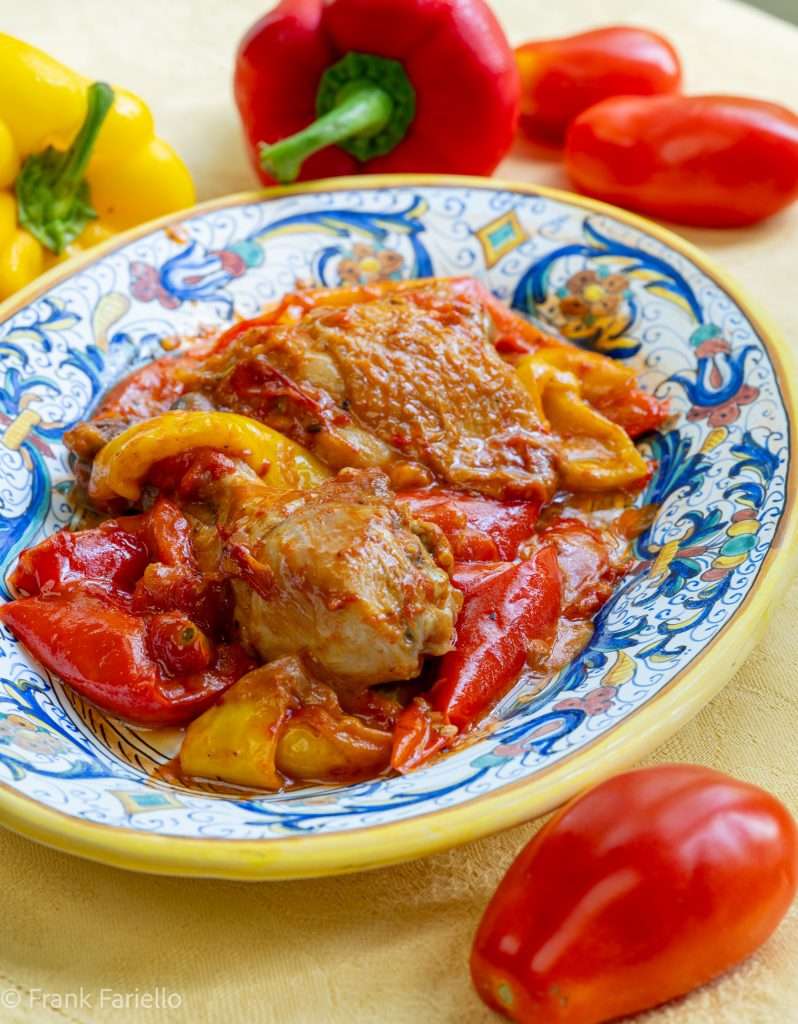
Notes on pollo con i peperoni alla romana
For best results, use a heavy gauge sauté pan, braiser or rondeau with a cover. Ideally, it should be wide enough to accommodate all the chicken pieces in a single, snug layer.
The trickiest part of the recipe is making sure the chicken and peppers are both done around the same time. As mentioned, the chicken should be very tender. The peppers should be perfectly tender, too, perhaps even ‘melted’ a bit, but not actually falling apart. Some cooks hold back the peppers for a time before adding them to the braise. This way they retain some of their bite. I find our local bell peppers need the full 30 minute braise to cook, same as the chicken. But if you can avoid this quandary entirely by cooking the chicken and peppers separately. (See Variations below for details.)
Choosing the chicken
An organic, free range chicken, of course, provides the best flavor and texture. They seem to be the only ones these days that taste like chicken. And they are less likely to shed a lot of liquid, not having been pumped up with water and who knows what else. Also quite good are the ‘yellow chickens’ I can find at my local Chinese supermarket. Complete with head and feet that you can use for broth, they also have wonderful flavor.
Although pollo con i peperoni is traditionally made with a whole, cut up chicken, I find it’s really the legs that stand up best to the long braise. I usually reserve the breast for quickly made dishes like scalloppine, cutlets or pollo al burro. So if you wanted to buy chicken legs and cut them in thigh and drumstick, go right ahead.
How to cut up a whole chicken
Here’s how you cut up a whole chicken for this recipe and any other spezzatino for that matter.
Cut off each of the legs from the chicken, then the wings. Then cut the breasts off the back of the chicken. (You can freeze and save the back for broth.) Divide each leg into thigh and drumstick at the joint. Cut the breasts into two down the center rib, then divide each breast horizontally into two or three pieces, depending on its size, cutting through the bone. Then trim the boney tips off the wings. (These too can be saved for broth.)
You’ll wind up with 4 leg pieces, 4 or 6 breast pieces and 2 wings. They should all be roughly the same size.
Cookng the chicken
For best flavor, make sure to brown the chicken well all over. It’s best not the crowd the pan, so if need be you can proceed in batches.
As for the braise, check on the chicken for doneness after 30 minutes or so. Some chickens, especially the factory farmed kind, can give off a lot of liquid. If this is the case, you can raise the heat a bit and cook off the excess. The sauce should be quite well reduced and cling to the chicken pieces—more of a ‘dressing’ than an abundant sauce.
Choosing and prepping your peppers
Pollo con i peperoni alla romana is one dish where good old fashioned bell peppers work best. Slender horn shaped varietals are wonderful for frying on their own, but for this dish bell peppers are preferable. They have enough heft to stand up to the long braise required here. Use any color you fancy, or even better, a mix of colors. Red and yelllow would be most typical.
You can check out this post for a quick tutorial on trimming and slicing bell peppers. For pollo con i peperoni alla romana, you should slice the peppers into large, rather chunky pieces or wide slices. Thin slices would tend to fall apart during the braise.
Choosing and prepping the tomatoes
Just about any kind of tomato will work in this recipe, provided they’re flavorful and ripe. For that reason, the summer is, of course, the best time to make this dish. Perhaps the best are San Marzano or another plum tomato, which will reduce nicely into a sauce-like consistency, which is just what you want.
If you don’t have access to flavorful fresh tomatoes, you could substitute canned or jarred peeled tomatoes or even a dash of tomato passata. In fact, some recipes call for these, but if you’re making your pollo con i peperoni in late summer, it’s a shame not to take advantage of nature’s bounty.
Peeling the tomatoes is optional but the skin can be tough so it’s nice to remove it. You just need to quickly blanch them for a few seconds in boiling water and the skins shoudl come right off. You can also char them over an open flame as you would peppers.
Variations
The main variations for making pollo con i peperoni relate to whether you cook the peppers separately or together with the chicken. Personally, I prefer to cook them together as per the recipe above. That way you don’t need to dirty an extra pot. Plus it gives the peppers time to infuse the chicken deeply with their zesty flavor. On the other hand, cooking them separately does give you more control over how done each is.
The famed Sora Lella, in fact, would sauté the peppers separately and add them to the chicken to finish cooking. In another particularly elegant variation, you roast the peppers over an open flame or in a hot oven, then peel and slice them before adding them to the chicken just a few minutes before it’s done. Or even on top of the already plated chicken. As noted above, in some recipes, you add uncooked peppers halfway through the braise, not a bad idea if you’re using mini or frying peppers, which will cook more quickly than bell peppers.
Feel free also to play around with the measurements. You can stretch the dish by using more peppers. And if you want a saucier dish, then use more tomatoes or a generous pour of passata.
Other variations include the use onions rather than garlic, which leans into the natural sweetness of the peppers. In some you use both. In yet other recipes, you omit the alliums altogether.
You will see some recipes where you add fresh herbs, typically rosemary or sage, or both, to braise along with the chicken. While these herbs are very common pairings with chicken in Italian cookery, here I find they only distracts from the flavor of the peppers.
Elena Fabrizi, aka Sora Lella

Elena Fabrizi, popularly known as Sora Lella, was a celebrated Italian actress, television personality and restaurateur.
As an actor, she was known for her genuine, straightforward Roman comedy, often taking on roles as a good-natured, grumbling grandmother. She began her film career in the late 1950s. Her acting career peaked in the early 1980s, notably through a series of films directed by Carlo Verdone. She earned prestigious awards, including a Silver Ribbon for Best New Actress for Bianco, rosso e Verdone and a David di Donatello for Best Supporting Actress for Acqua e sapone.
Elena Fabrizi made frequent appearances on Italian TV, as a regular guest on the Maurizio Costanzo Show and as a character in six episodes of the 1982 television mini-series Storia d’amore e d’amicizia.
Restauranteur and gastronome
Although she was famous for her film and TV appearances, Elena considered acting just a hobby. Her true profession was as a restaurateur and gastronome. Along with her husband, she opened her eponymous restaurant Sora Lella in 1959. She was the woman behind the stove for decades, making it a well known spot for boldly flavored traditional Roman food.
She was also perhaps the first TV chef in Italy, sharing traditional Roman recipes like pollo con i peperoni on various television programs. Here are some clips of that famous TV appearance on August 12, 1967, as she shops for ingredients in Campo de’ Fiori and, back at her restaurant, makes her version of the dish she helped made famous:
Fabrizi was also a cookbook author, penning La Cucina della Sora Lella (1992), a multi-volume collection of her recipes. It’s sadly out of print, but if you want tolearn more about her cooking, you can still pick up Annamo bene. La cucina romana di Sora Lella, (2022), a collection of her recipes and a comprehensive guide to traditional Roman cuisine, written by her grandchildren, who still run her restaurant. It is available on amazon.com.
Ferragosto, the ultimate Italian summer holiday
Ferragosto is a major Italian public holiday. Celebrated on August 15, it marks the peak of the Italian summer vacation season, a time when many Italians escape the cities to head for the beaches, mountains, or countryside.
The holiday has ancient roots. It was originally established by Emperor Augustus in 18 BCE as Feriae Augusti to provide a period of rest after the intense labor of the agricultural harvest. During these ancient celebrations, horse races were organized, and working animals were given a break and decorated with flowers.
Originally observed on August 1, the Catholic Church later moved the celebration to August 15 to coincide with the Feast of the Assumption of Mary, blending the ancient Roman traditions with the religious holy day.
Today, Italians celebrate Ferragosto with family gatherings, outdoor lunches, barbecues, and various local festivals across the country. The modern custom of traveling during Ferragosto became popular during the Fascist era in the 1920s. The government organized People’s Trains of Ferragosto with highly discounted tickets, allowing lower-class families to visit the seaside or the mountains for a few days. Since the government didn’t provide food, the tradition of packing lunches and having barbecues on Ferragosto began.
Ferragosto and pollo con i peperoni
Like so many holidays in Italy, a central part of Ferragosto is a long, leisurely lunch, often outdoors. Grilling is de rigueur on Ferragosto, but in Rome the quintessential main course is pollo con i peperoni.
A braised dish during the hottest period of the year may seem a bit odd, but if you think about it, Romans have good reasons, rooted in seasonality and practicality, for eating pollo con i peperoni on Ferragosto. The first chickens of the year—typically born in early spring—reach their peak flavor by mid-August, while sweet peppers and tomatoes are, of course, are perfectly ripe and in season. Moreover, pollo con i peperoni actually tastes better a day after you make it, making it ideal to prepare ahead and pack for a Ferragosto outing.
Making pollo con i peperoni ahead
As mentioned, you can make pollo con i peperoni entirely ahead. Just reheat it gently when you’re ready to cook. It only get better after a rest. It will keep for several days in the fridge. And alhough I’ve never tried it myself, I’d imagine it freezes well.
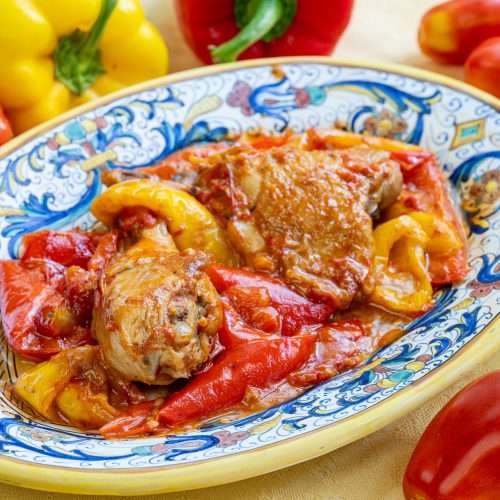
Pollo con i peperoni alla romana
Ingredients
- One chicken preferably free range, cut up into serving pieces
- 3-4 large bell peppers sliced into large pieces or wide strips
- 4-5 fresh tomatoes peeled and cut into chunks
- 1-2 cloves of garlic peeled and lightly crushed
- Salt and pepper
- White wine
- Olive oil
Instructions
- In a sauté pan, braiser or rondeau, sauté the chicken pieces in abundant olive oil over a moderate flame until golden brown all over.
- Add the garlic and season the chicken well with salt and pepper, turning the pieces so they are evenly seasoned.
- As soon as you smell the garlic’s aroma, drizzle over some white wine and allow it to evaporate, again turning the pieces so they are evenly coated.
- Add the tomato and cover. Let it simmer along with the chicken for a few minutes, until it begins to melt into a kind of sauce.
- Add the peppers to the pot. Lower the heat, cover and let the chicken and vegetables braise for a good 30-45 minutes, or until the peppers are fully cooked and the chicken is falling off the bone tender.
- Uncover the pan and, if there are excess juices, raise the heat and let it cook off a bit, until you have a rich sauce that clings to the chicken.
- Serve hot or warm. It is also quite good at room temperature.
Nutrition
Discover more from Memorie di Angelina
Subscribe to get the latest posts sent to your email.


One can never have enough chicken recipe! This looks divine!
Thanks, Angie! I know you love chicken. 😉
E bo, I’m trying to only use what’s in the deep freeze. Living now in rural New Mexico, we want to empty it out as much as possible before we harvest from our orto, & the local farmer’s markets. The chicken I pulled out is pork! In the spirit of Italian cucina povera, I’m going to make this with the pork. I’m sure someone in la citta eterna has done it with a pork loin! That will pair beautifully with the garden sage!
I’m sure it pork loin and peppers would be perfectly delicious, Sebastian. Enjoy!
Another amazing post + recipe, Frank! While I’m familiar with the actual recipe here, I wasn’t as familiar with Elena Fabrizi and the Ferragosto holiday. I love the backstory behind food as it really brings the dish to life. Thanks for sharing…and now I’m craving chicken and peppers!
Thanks, David! I couldn’t agree more than a good backstory really brings a recipe to life. Food is culture.
What a great recipe, and I loved the video! The only word I understood was amore. I love how the host couldn’t get a word in edgewise!!!
Hehe!
Buon Agosto Frank! This is a preparation we fell in love with a number of years ago at Armando al Pantheon and I’ve made it ever since. The peppers in Rome, where we shop, are incredible. I mostly roast and peel the peppers outdoors before making the chicken. I don’t know if they do that at Armando but we sort of thought they might. It’s now on the to-make list because our locally grown peppers are available at our farmer’s market.
I can imagine they make a fantastic version of it at Armando’s. And now is the perfect time to enjoy it! Thanks for stopping by, Phyllis.
We eat salads and cheeses for a few weeks now; it’s because of tremendous heat but this beauty deserves to turn my stove on. Really.
It’s worth it, lol!
This recipe looks very similar to the French ‘Poulet Basquaise’ which comes from Southwest France, except it might be a tad spicier with the addition of some paprika. Such a lovely combination of the acidity of the tomatoes with the slight ‘tang’ of the peppers. I watched the video of Sora Lella; even though I didn’t understand the language, I could tell she showed complete authority over the situation. I loved the way she bit into the pepper at the market to see if it was fresh!
Sound very similar indeed. I’ll have to try it some time.
Glad you liked the Sora Lella video. She’s a treasure. And very funny if you understand her Italian. Actually she was tasting the pepper to see if it was sweet. An interesting tidbit: she says three pointed peppers tend to be hot/spicy. Not sure that’s true but I guess that’s a bit of local folk wisdom!
Well, I think you know which of the variations I’ll be making! I’ve always loved the look of this dish as it’s so colorful. And the flavors can’t be beat. This is definitely the time to make it — the tomatoes and peppers have been fantastic here. And we have two new chicken vendors at the farmers market. I’ll circled back when I’ve made it.
I loved watching Sora Lella — my Italian isn’t good as to keep up with the conversation, but it sounded like he was saying that it was like Pollo Marengo and she was saying that it wasn’t. Fun video.
Ah yes, I can guess! It’s also very good with onion. Peppers and onions go so well together. I hope you enjoy it!
And if you understood that much of the video, then your Italian must be pretty good! Especially since Sora Lella isn’t easy to understand; she speaks a very “romanesco” Italian. They were talking about Chicken Marengo. The host was commenting that there are lots of great recipe for chicken, and then starting reading the story behind Marengo from a book. As you saw, she wasn’t having any of it. Shaking her head as he read, she said “Non mi piace”–I don’t like it [Marengo]. “I like pollo alla romana. And if Napoleon ever came to Rome, that’s what I’d serve him!” The implication being that if he ever tasted this dish, he’d forget all about Chicken Marengo.
Sounds delicious!
Thanks, Barb!
You have told us about a special Roman holiday, provided a succulent chicken recipe to copy and told us about a rather special Roman lady from just before the time I began cooking . . . and, actually, my first trip to the Eternal City . . . thank you 🙂 !
You’re welcome, Eha! Glad you enjoyed it all. And I hope you try the recipe.
That looks delicious – I can almost taste the peppers, because I cook a Spanish lamb dish (Cordero al Chilindrón), from Aragón, made with tomatoes and 3 red peppers cut into strips.
I love the video of Sora Lella – I fiddled with the settings to watch it in Italian, as opposed to the default, dubbed in English!
That sounds amazing, too, MD. Clever you to find English dubbing! Did it make any sense? Sora Lella speaks a very dialectical Italian..
I can understand a lot of Italian words (especially those for food), relative to speaking French and Spanish. I understand a lot of Catalan too and learned Latin at school.