


Of all the many frozen desserts for which Italy is justly famous, this one is practically unknown: coviglia, a kind of semifreddo unique to Naples.
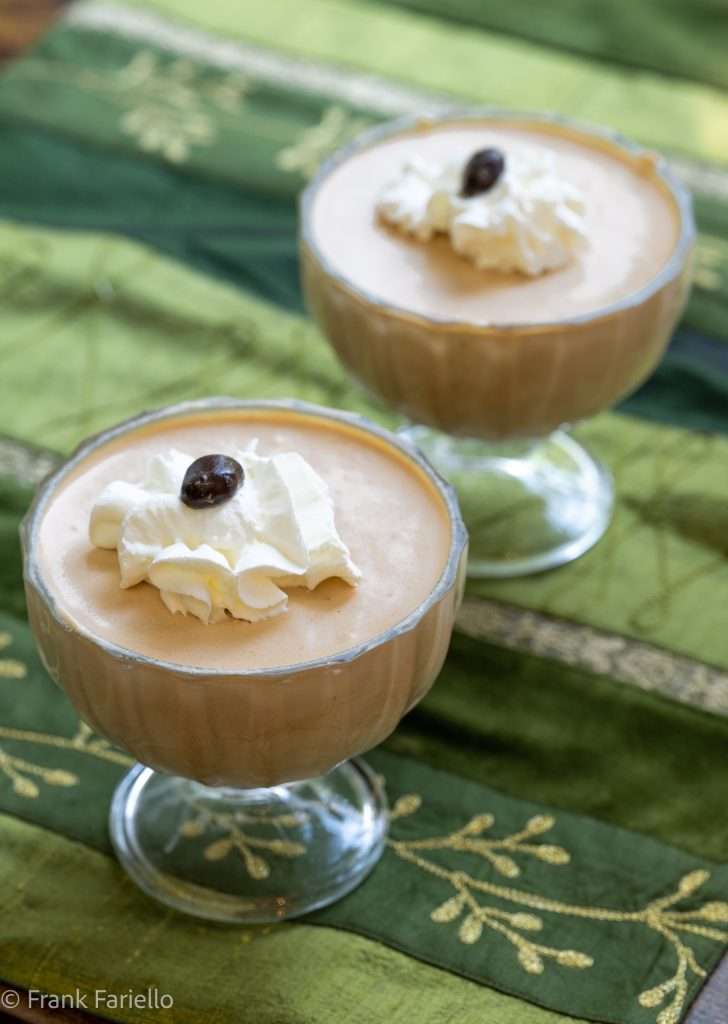
A coviglia napoletana is made with a rich combination of egg yolk whipped with sugar until creamy, folded together with whipped cream and a meringue of egg white whipped with sugar until thick and frothy, classically flavored with either espresso or melted chocolate. The mixture is then popped right into the freezer. There’s no need for churning, since the air produced by the whipping, along with fat and sugar, prevent the mixture from freezing hard. What you get instead is a rich, velvety and gorgeously dense mouthfeel.
Traditionally, you serve coviglia in small metal cups which gives it its name, which is derived from the Spanish word cubillo, literally a small bucket, a legacy of the long Spanish dominion over southern Italy. Today freeze-proof glass, wax paper or even plastic are more common serving vessels.
A forgotten classic
Coviglia has an illustrious history. Its name suggests origins during the Spanish Bourbon period, and it was developed gradually between the 17th and 19th centuries. Food historians treat it as one of the key transitional desserts between the old-style sorbet and modern gelato. Naples at the time was considered the capital of frozen desserts.
By the 1800s coviglia had become genuinely popular, especially in coffee and chocolate flavors, spreading through Neapolitan society and persisting after Italian unification in 1860, when Naples was no longer a capital but continued to draw European visitors curious to taste local specialties, famously including the Empress Elizabeth of Austria, popularly known as Sisi.
You’ll find recipes for coviglia in both of the great Neapolitan cookbooks of the period, later editions of Vincenzo Corrado’s 1737 Il Cuoco galante and Ippolito Cavalcanti’s 1837 La cucina teorico-pratica.
By the 20th century coviglia had become a fixture of home entertaining. No baptism, communion, or birthday buffet was complete without coviglie in a few flavors, usually alongside its cousin the spumone. The following recipe is adapted from Jeanne Caròla Francesconi’s iconic 20th century cookbook La cucina napoletana. which is where I first came across it.
Sadly, today coviglia has almost been forgotten. The Gran Caffè Gambrinus, a veritable Naples institution since 1860, is famous for its coviglie, including a special violet flavored one named in Sisi’s honor. And you can find it at a few other coffee shops and gelaterie around town. They say ironically, coviglia is a bit more popular up north than in its native town, but personally I’ve never come across it. Needless to say, it’s virtually unknown outside Italy.
What a shame, since it’s a delightful dessert, and an easy one to make at home. Perhaps it’s time for a coviglia revival?
Ingredients
Makes about six single servings
- 2-3 shots of espresso
- 1-2 Tbs sugar or other sweetener
For the meringue:
- 3 egg whites
- 100g (1/2 cup) granulated sugar
For the whipped cream:
- 500ml (2 cups) heavy cream
- 2 Tbs powdered (confectioner’s) sugar
For the egg yolk cream:
- 4 egg yolks
- 4 Tbs granulated sugar
Optional toppings:
- whipped cream
- chocolate covered coffee beans
- dark chocolate shavings
- cocoa powder
- chopped pistachios
Directions
Prepping the components
Prepare two shots of espresso coffee in a ‘moka’ coffee pot or espresso machine. Sweeten to taste. Let the coffee cool completely.
Prepare the meringue by whisking the egg whites with the sugar in a standing mixer until you have a glossy white foam that forms ribbons as you whisk.
Prepare the whipped cream by whisking the heavy cream and powdered sugar until it forms soft peaks.
In a large bowl, whisk the egg yolks and sugar together until it, too, is pale, thick and perfectly cream, forming ribbons as you whisk.
Mixing the coviglia batter
Add the coffee to the egg yolk cream and mix until thoroughly incorporated. Add the meringue and mix gingerly until fully incorporated as well.
Now add the whipped cream and fold gingerly fold it into the mixture with a spatula. Use a circular motion, scooping up from the bottom of the bowl until you have a uniform batter.
Freezing
Pour the batter into individual freezer proof serving cups, leveling off the tops so the batter is flush with the rims of the cups.
Freeze for at least three hours or overnight. If freezing for more than a few hours, cover with plastic wrap (cling film) to prevent freezer burn.
Serving
Let rest at room temperature for about 15 minutes before serving, garnished with one or more of the optional toppings if you like.
Notes on la coviglia napoletana
First off, a word to the wise: As you will have seen, this recipe calls for raw eggs. And freezing, unfortunately, does not kill salmonella. So if you have any doubts about the safety of your eggs or just don’t want to risk it, pasteurized eggs are the way to go.
Though the recipe for coviglia is quite simple, it does involve quite a bit of whipping, of all three elements of the base. It’s that whipping that creates the air which, along with the fat in the whipped cream, gives coviglia its dense but not hard texture when frozen.
Unless you have particularly strong arm muscles, a standing mixer definitely comes in handy. You’ll need to run it at top speed for all three elements. Since I only have one bowl, I make the meringue first, the whipped cream, removing each to another bowl after they’re done, and only then whip the egg yolk cream. Then I fold the meringue, followed by the whipped cream, back into the bowl.
Since the air is critical to getting the right texture, you need to take special care not to deflate the moisture as you fold it. Use a gingerly scooping motion, as you do so.
Variations
For this recipe, I’ve slightly modified a recipe from Jeanne Caròla Francesconi’s La cucina napoletana. More contemporary recipes generally call for much less whipped cream than she does, usually about half the amount given here, for a denser, darker, more coffee forward coviglia, which you can then top with more whipped cream if you like. Francesconi’s version is so light and creamy that it doesn’t really need a whipped cream topping, though personally I don’t mind gilding the lily.
Depending on your sweet tooth, you can vary the amount of sugar as well. Francesconi’s recipe actually calls for about double the amount of sugar called for in the recipe above (!) Personally I find that much too sweet. That said, I would use much less than indicated here, as you need the sugar for a proper, creamy smooth texture. Sugar lowers the temperature at which the batter freezes and prevents ice crystals from forming.
Other flavorings
As mentioned, the other classic flavor is chocolate. For a chocolate coviliga, gently melt about 200g (7 oz) dark chocolate and let it cool a bit before adding it to the egg yolk cream instead of the coffee.
Other flavorings include hazelnut, chestnut, pistachio, torrone, strawberry, amarena (sour cherry) and vanilla. You could even forgo flavorings altogether; the base is perfectly delicious on its own.
You can really go to town with the toppings as well, using whatever you find complements your flavoring. I’ve listed some of the more common ones in the main recipe.
Making coviglia ahead
You need to make your coviglia at least three hours ahead so it has time to firm up in the freezer. Longer than that and you should let the coviglia soften a bit at room temperature. If you’ve left it to freeze overnight or longer, it should rest say 15-20 minutes. Increase the rest time if you’ve used less whipped cream as most modern recipes call for.
Coviglia napoletana
Ingredients
- 2-3 shots espresso
- 1-2 Tbs sugar or other sweetener
For the meringue:
- 3 egg whites
- 100 g granulated sugar
For the whipped cream:
- 500 ml heavy cream
- 2 Tbs powdered (confectioner's) sugar
For the egg yolk cream:
- 4 egg yolks
- 4 Tbs granulated sugar
Optional toppings:
- whipped cream
- chocolate covered coffee beans
- dark chocolate shavings
- cocoa powder
- chopped pistachios
Instructions
Prepping the components
- Prepare two shots of espresso coffee in a ‘moka’ coffee pot or espresso machine. Sweeten to taste. Let the coffee cool completely.
- Prepare the meringue by whisking the egg whites with the sugar in a standing mixer until you have a glossy white foam that forms ribbons as you whisk.
- Prepare the whipped cream by whisking the heavy cream and powdered sugar until it forms soft peaks.
- In a large bowl, whisk the egg yolks and sugar together until it, too, is pale, thick and perfectly cream, forming ribbons as you whisk.
Mixing the batter
- Add the coffee to the egg yolk cream and mix until thoroughly incorporated. Add the meringue and mix gingerly until fully incorporated as well.
- Now add the whipped cream and fold gingerly fold it into the mixture with a spatula. Use a circular motion, scooping up from the bottom of the bowl until you have a uniform batter.
Freezing
- Pour the batter into individual freezer proof serving cups, leveling off the tops so the batter is flush with the rims of the cups.
- Freeze for at least three hours or overnight. If freezing for more than a few hours, cover with plastic wrap (cling film) to prevent freezer burn.
Serving
- Let rest at room temperature for about 15 minutes before serving, garnished with one or more of the optional toppings if you like.
Nutrition
Discover more from Memorie di Angelina
Subscribe to get the latest posts sent to your email.


The dessert itself sounds incredible, rich, velvety, and somehow both old‑fashioned and timeless. Honestly, it’s wild that something this elegant has become almost forgotten, because it looks like the kind of treat that would steal the show at any gathering.
It’s true… such a shame!
What a gorgeous dessert, I will bookmark it for the warmer days.
Hope you like it, Eva!
So you’re saying that coviglia is the ancestor of gelato? Well, given how much I love gelato, I think I’m duty-bound to try this recipe! Plus, I absolutely love coffee-flavored desserts!
Well then, this will be right up your alley, David. Enjoy!
ooh did my comment work? Just saying this sounds wonderful!
sherry https://sherryspickings.blogspot.com/
Thanks!
this sounds wonderful Frank. we are lucky in australia that we don’t have to worry about eating raw eggs!
cheers
sherry https://sherryspickings.blogspot.com/
You are lucky, Sherry! I don’t worry too much about it, but some folks do.
This brings me back to my childhood! My aunt used to make coviglie and you’re right, no event, including pranzo della Domenica, was complete without coviglie and spumoni! Thank you for this sweet memory!
I’m so glad I could bring back those lovely memories, Paola!
Incredible! I’ve never heard of this and I must make it! I do love a semifreddo…
It’s a winner if you ask me, Mimi. Thanks for stopping by!
Reminds me of frozen panna cotta or zabaglione dessert. Will definitely try this, maybe for Thanksgiving dessert. Grazie mille…
Hope you like it, Jerry. Thanks for your comment!
Such a rich and creamy dessert! Would love to make it some time.
Your posts still haven’t showed up in my Feedly 🙁
But they are now… 😉 Thanks for stopping by, Angie!
Sounds delicious!
Thanks, Barb!
Love the story, love the history and the explanatory read . . . thanks from a non-dessert eater always interested . . .
Am just reading Angie;s comment – I have been having problems also and quite a few of the comments I have made have not appeared on your posts – just explaining 🙂 !
Sorry to hear it, Eha. Hopefully corrected now.
You’re welcome, from a fellow non dessert eater. 😉
A forgotten dessert indeed. I researched it years ago and I could not find much information.
My (first) edition of Francesconi doesn’t feature them and yet I remember reading her (did I find them in her later book on Neapolitan cookery? Which edition of La Cucina Napoletana did you use, please, Frank?). I think I then settled on Anna Gosetti della Salda’ s version but I do not recall being very impressed.
Unfortunately eggs are not salmonella free here in Italy and the pasteurised ones I tried didn’t taste that convincing but, above all, they were of unclear origin – definitely they were not organic. There are now versions using a pate a bombe, but somehow I never got round to try them). It is one of those recipes that has remained a thorn in my culinary adventures. Stefano
I have the third edition, 1997. The recipes for coviglie are Nos. 715-718.
As far as egg safety is concerned, tbh I just look for organic ones and hope for the best… but thanks for the reminder that I should include a warning in the notes!
This sounds delightful, Frank — I look forward to making it with chocolate. Maybe 3-4 ounces? I love the history — it always amazes me that dishes like this go out of fashion.
It’s a matter of taste but yes, 100g (3-1/2 oz) give or take should work well. Enjoy! It really is a shame this has been (almost) lost to time.
That sounds delicious – I’m drinking an espresso now and can almost taste a coviglia! Thanks for bring it to my attention. I don’t know of a similar Spanish pudding.
You’re welcome! It’s definitely worth a try if you have a hand or standing mixer. I’d shudder at the thought of whisking by hand. 😉